

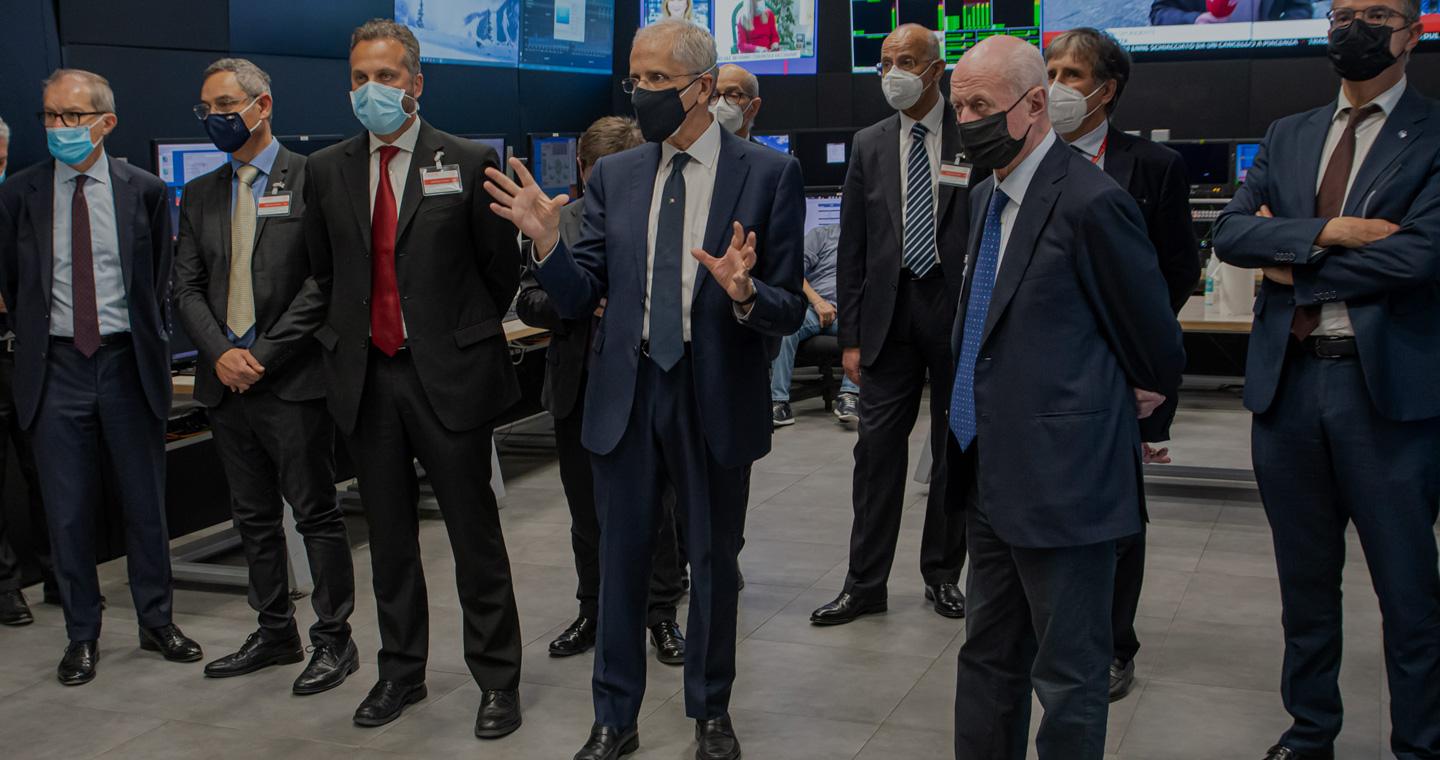
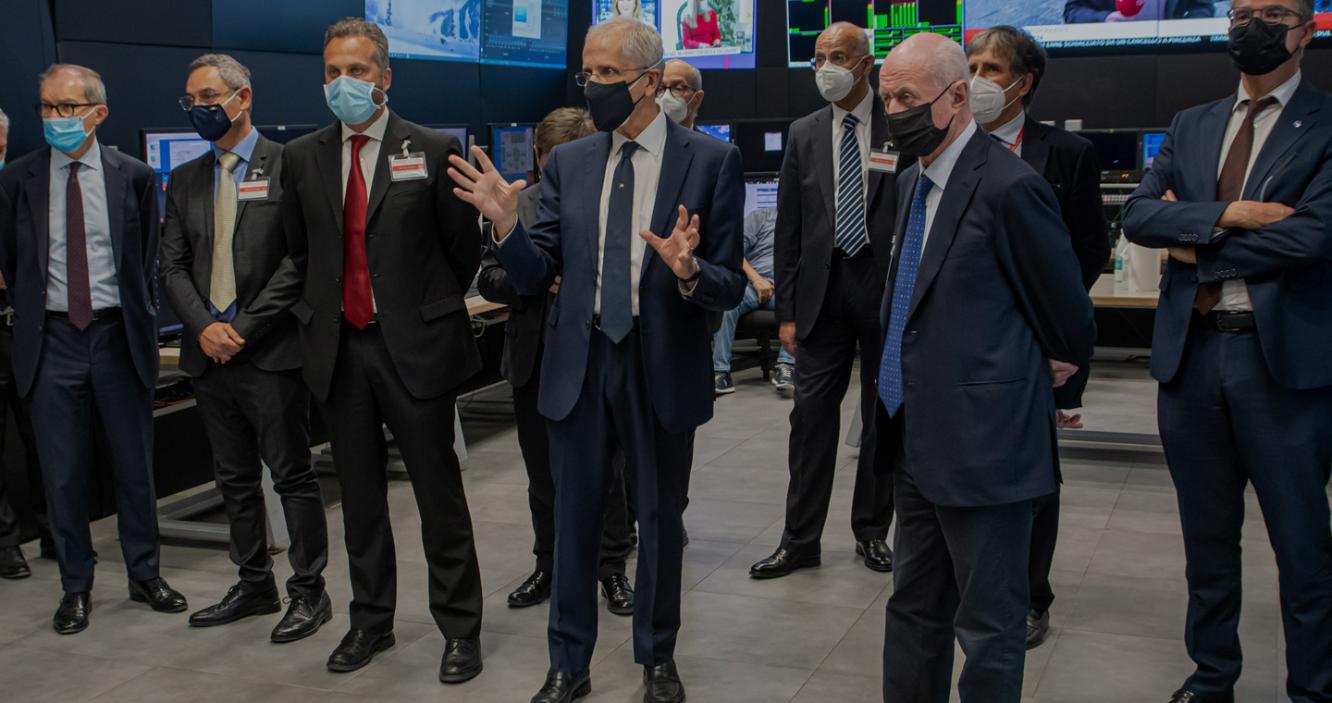
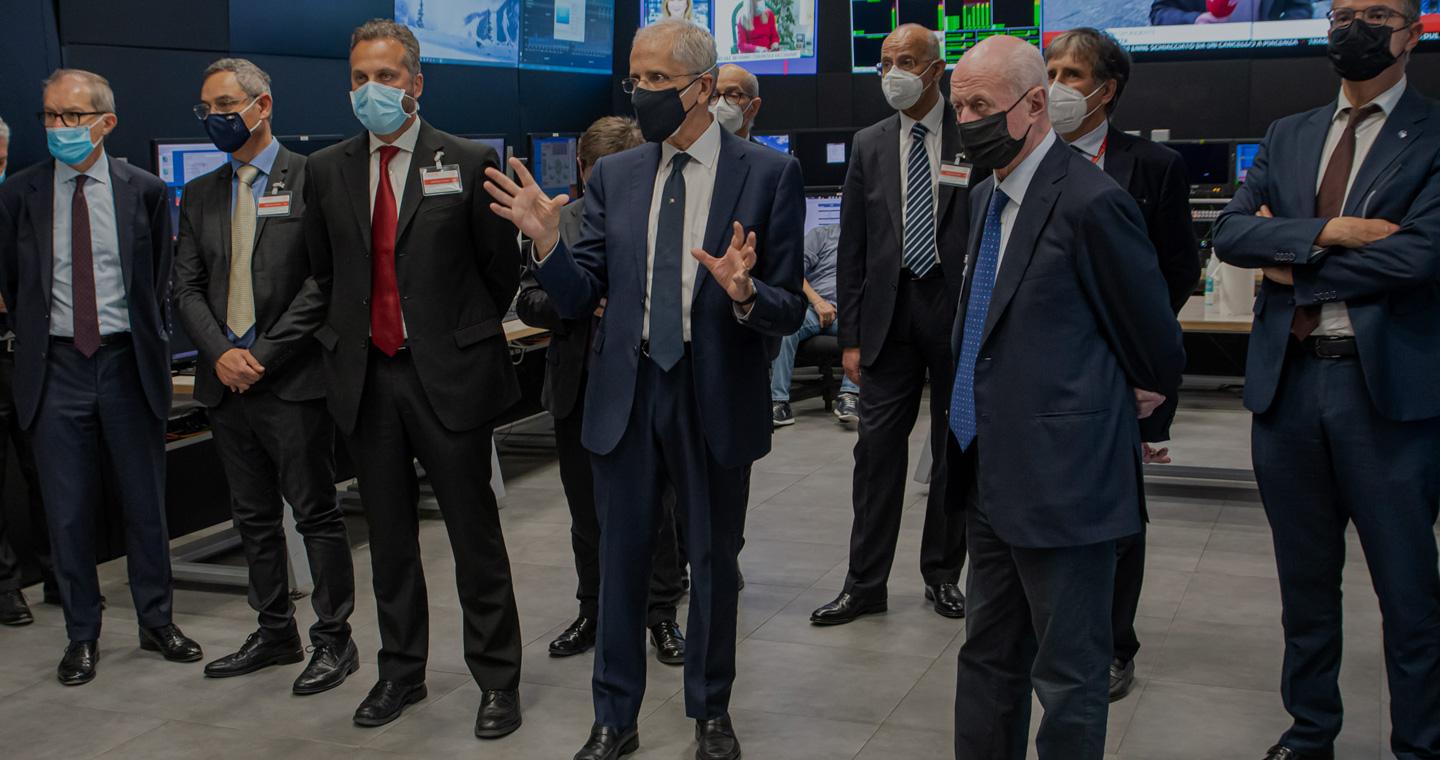
Undersecretary Tabacci visits the Fucino Space Centre

18 May 2021

Bruno Tabacci, Undersecretary of State to the Presidency of the Council in the Draghi government with a mandate for Economic Planning and Coordination and Aerospace, visited Telespazio’s Fucino Space Centre today 18 May. 

Undersecretary Tabacci was welcomed to the Fucino Space Centre by Luigi Pasquali, Coordinator of Leonardo’s Space Activities and Telespazio CEO. The visiting delegation also included general Luigi Francesco De Leverano, Deputy Chief of the Defence General Staff and Military Counsellor to the Presidency of the Council, Giorgio Saccoccia, President of the Italian Space Agency, and Thales Alenia Space Italia CEO Massimo Comparini.

With 170 antennas in a 370,000 square metre area, “Piero Fanti” Space Centre in Fucino, in the province of L’Aquila, has been in operation since 1963 and is regarded as the world’s first and most important civil teleport.

At the Space Centre, Telespazio not only launches into orbit and controls satellites and telecommunications, television and multimedia services but operates its Control Centre for the COSMO-SkyMed Earth Observation satellite constellation and one of the two Control Centres managing the European Galileo satellite navigation and localisation system.

“Fucino represents the heart and the history of Telespazio’s work and of space communications in Italy. The presence of Undersecretary Tabacci, General De Leverano and President Saccoccia offers proof of the constant support of the institutions for Italy’s space industry, and I am particularly happy that this opportunity should emerge in the year in which we celebrate Telespazio’s 60th birthday, for the company took its first steps in the newly emerging satellite communications industry in Fucino in the early ’60s.”

Luigi Pasquali – Telespazio CEO.

Before going to the Fucino Space Centre, Undersecretary Tabacci had visited the Thales Alenia Space Satellite Integration Centre in Rome. The two centres are the pride and joy of the Space Alliance between Leonardo and Thales, a strategic partnership which began in 2005 and includes the two joint venture, Thales Alenia Space and Telespazio.

Other News & Stories

25.09.2026
Fucino Space Centre: from the first "ping" to the future of the Internet

Prof. Luciano Lenzini, a pioneer in bringing the Internet to Italy, met with Telespazio engineers and technicians at the Fucino Space Centre, through which the first Internet link between Italy and the United States passed 40 years ago.

21.09.2026
Connectivity: results of the satellite trial in Lombardy presented in Milan

Connecting entire villages to the national network through an infrastructure that combines satellite, fiber and wireless connections, in order to bring quality digital services even to the hardest-to-reach areas. This is the goal of the trial carried out in Lombardy, whose preliminary results were presented at the Milan office of the Department for Digital Transformation. Telespazio took part in the initiative by developing a proprietary backhauling solution that aggregates multiple satellite links.

15.09.2026
FLEX and Sentinel-3C in Orbit: Leonardo and Telespazio's Contribution to ESA's Earth Observation Missions

On September 15th 2026, at 03:21 Italian time, the FLEX and Copernicus Sentinel-3C satellites of the European Space Agency (ESA) successfully launched from Europe's Spaceport in Kourou, French Guiana. Both travelled aboard the same launcher, Avio's Vega-C, and are now flying in tandem orbit, spaced roughly ten seconds apart, at an altitude of around 800 kilometres.

28.08.2026
MTG-I2 successfully launched: Telespazio acquired the first signal from the third Meteosat Third Generation satellite from the Fucino Space Centre

MTG-I2, the third Meteosat Third Generation satellite from ESA and EUMETSAT, lifted off yesterday, 27 August, at 20:11 UTC from the Kourou spaceport in French Guiana, aboard an Arianespace Ariane 6 launcher. About 25 minutes after launch, Telespazio's Fucino Space Centre — a Leonardo Group subsidiary — acquired the satellite's first signal, officially marking the start of the LEOP (Launch and Early Orbit Phase), which will last twelve days.

25.09.2026
Fucino Space Centre: from the first "ping" to the future of the Internet

Prof. Luciano Lenzini, a pioneer in bringing the Internet to Italy, met with Telespazio engineers and technicians at the Fucino Space Centre, through which the first Internet link between Italy and the United States passed 40 years ago.

21.09.2026
Connectivity: results of the satellite trial in Lombardy presented in Milan

Connecting entire villages to the national network through an infrastructure that combines satellite, fiber and wireless connections, in order to bring quality digital services even to the hardest-to-reach areas. This is the goal of the trial carried out in Lombardy, whose preliminary results were presented at the Milan office of the Department for Digital Transformation. Telespazio took part in the initiative by developing a proprietary backhauling solution that aggregates multiple satellite links.

15.09.2026
FLEX and Sentinel-3C in Orbit: Leonardo and Telespazio's Contribution to ESA's Earth Observation Missions

On September 15th 2026, at 03:21 Italian time, the FLEX and Copernicus Sentinel-3C satellites of the European Space Agency (ESA) successfully launched from Europe's Spaceport in Kourou, French Guiana. Both travelled aboard the same launcher, Avio's Vega-C, and are now flying in tandem orbit, spaced roughly ten seconds apart, at an altitude of around 800 kilometres.

28.08.2026
MTG-I2 successfully launched: Telespazio acquired the first signal from the third Meteosat Third Generation satellite from the Fucino Space Centre

MTG-I2, the third Meteosat Third Generation satellite from ESA and EUMETSAT, lifted off yesterday, 27 August, at 20:11 UTC from the Kourou spaceport in French Guiana, aboard an Arianespace Ariane 6 launcher. About 25 minutes after launch, Telespazio's Fucino Space Centre — a Leonardo Group subsidiary — acquired the satellite's first signal, officially marking the start of the LEOP (Launch and Early Orbit Phase), which will last twelve days.