





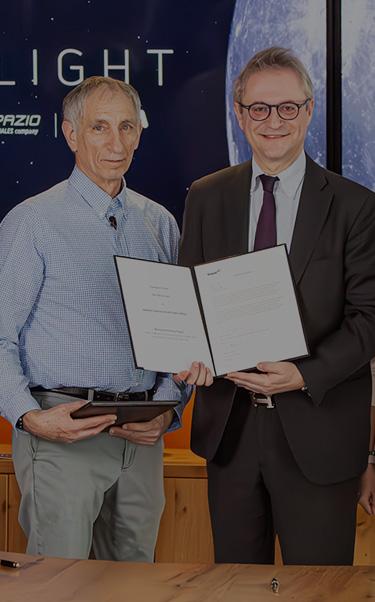
Viasat, Inc. (NASDAQ: VSAT), a global leader in satellite communications, today joined the European Space Agency’s Moonlight project (“Moonlight”), alongside program lead Telespazio.
Moonlight is the European Space Agency's (ESA) program to develop a lunar orbiting Navigation and Communication system that will greatly enhance combined navigation and communications services for European and international missions both on the surface of the Moon and in lunar orbit.
The Moonlight communications system will act as a data highway on and around the Moon, and between Earth and the Moon. People, spacecraft, and lunar vehicles can access that data highway to simplify and speed communications among themselves and back to earth to better enable their scientific and exploration projects including their position over the Moon. Over time, Moonlight is anticipated to support additional commercial activities on the Moon such as space tourism, and manufacturing programs leveraging rare materials found on the lunar surface.
Viasat will be responsible for the design and development of the communication network and will lead the definition of the end-to-end communications services: aiming to provide a communications network for lunar landers, rovers, orbiters, and other technology. Viasat will also be responsible for the communication earth ground infrastructure and communication lunar surface user terminals.
Telespazio, as Moonlight program lead, has executed a contract with Viasat for the initial design phase of the communication system. This work will be fully funded by the European Space Agency throughout Phase 1.
The UK Space Agency, as one of the major contributors to ESA’s Moonlight program, selected Viasat to lead the UK ecosystem to deliver the communications capability. Moonlight services will be deployed in phases, targeting initial capability at the end of 2028 with full operations aimed by 2030.
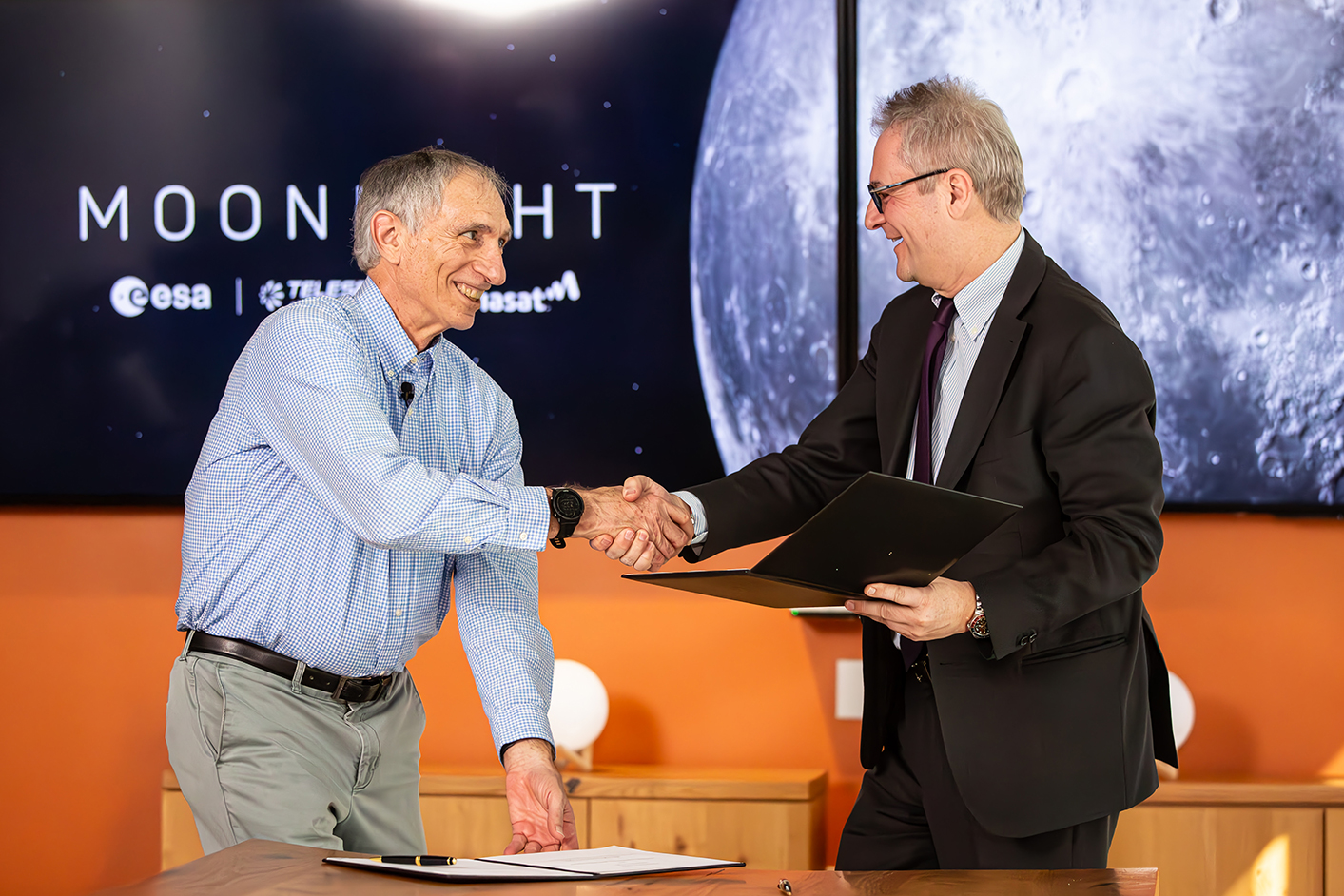
From left: Mark Dankberg, Chairman and CEO, Viasat and Gabriele Pieralli, CEO, Telespazio.
“Moonlight is among the most forward looking and exciting projects undertaken by the European Space Agency and the UK Space Agency. Viasat’s participation builds on our heritage of delivering and operating highly innovative and ambitious satellite communication programs. Alongside Telespazio, we look forward to supporting the Space Agencies by leveraging our commercial orientation, network engineering and operational skills, to reliably and securely support future generations of space exploration.”
Mark Dankberg, Chairman and CEO, Viasat.
“This marks a pivotal milestone in our commitment to the Moonlight program. By partnering with a global leader in satellite communications, we can harness cutting-edge technologies to create a secure and efficient communications and navigation infrastructure — essential for the success of lunar missions. This collaboration reinforces our drive to innovate and deliver comprehensive solutions, paving the way for a new era in lunar exploration and resource utilization.”
Gabriele Pieralli, CEO, Telespazio.
"Moonlight is a game-changer for lunar exploration. By providing reliable communications and navigation as a service, we're enabling future missions to dedicate more of their payload capacity to mission-critical instruments. This interoperable infrastructure will significantly enhance mission capabilities while reducing complexity and cost, ultimately accelerating humanity's return to the Moon."
Laurent Jaffart, ESA’s Director of Connectivity and Secure Communications.
“The Moonlight initiative will showcase Viasat’s and the UK’s leadership in emerging commercial markets such as the lunar economy. Once developed, the service will not only advance our capabilities across satellite communications but also provide reliable navigation and communication services to the growing number of commercial and institutional missions to the lunar surface over the next decade. “Viasat is a crucial addition to the Moonlight partnership, and the new lunar economy, driving innovation and creating high-skilled jobs across the country.”
Craig Brown, Investment Director at The UK Space Agency.
“Moonlight is steadily taking shape, and the inclusion of Viasat marks a significant milestone towards the provision of communications and navigation services for future ambitious lunar missions. Italy is proudly at the forefront of this endeavour, with ASI strong support and through its leading industrial excellence, aiming at playing a major role in a sustainable presence on the Moon.”
Giancarlo Varacalli, Head of Telecommunications and Navigation at the Italian Space Agency (ASI).