

40 years ago, Italy’s first connection to the Internet thanks to the antennas of the Fucino space Centre

30 April 2026

On April 30, 1986, Italy joined the global network that in the following years would become the Internet for the first time. The connection was made possible thanks to the key role of the Fucino space Centre, whose antennas carried the signal that connected the country with the United States.

On that day, the computing system of CNUCE (Centro Nazionale Universitario di Calcolo Elettronico) in Pisa was connected to the U.S. ARPANET (Advanced Research Projects Agency Network), marking Italy’s entry into the international network of computers that would go on to revolutionize communication, research and society.

With this connection, Italy became the fourth country in the world (after Norway, the United Kingdom and West Germany) to access the network originally developed in the United States.

The connection was made possible thanks to the SATNET satellite network, created through the collaboration between the National Research Council (CNR), Telespazio and Italcable. The signal started from CNUCE in Pisa, reached the Fucino Space Centre and from there was transmitted to the Roaring Creek station in Pennsylvania, allowing Italian researchers to connect to the U.S. network of computers.
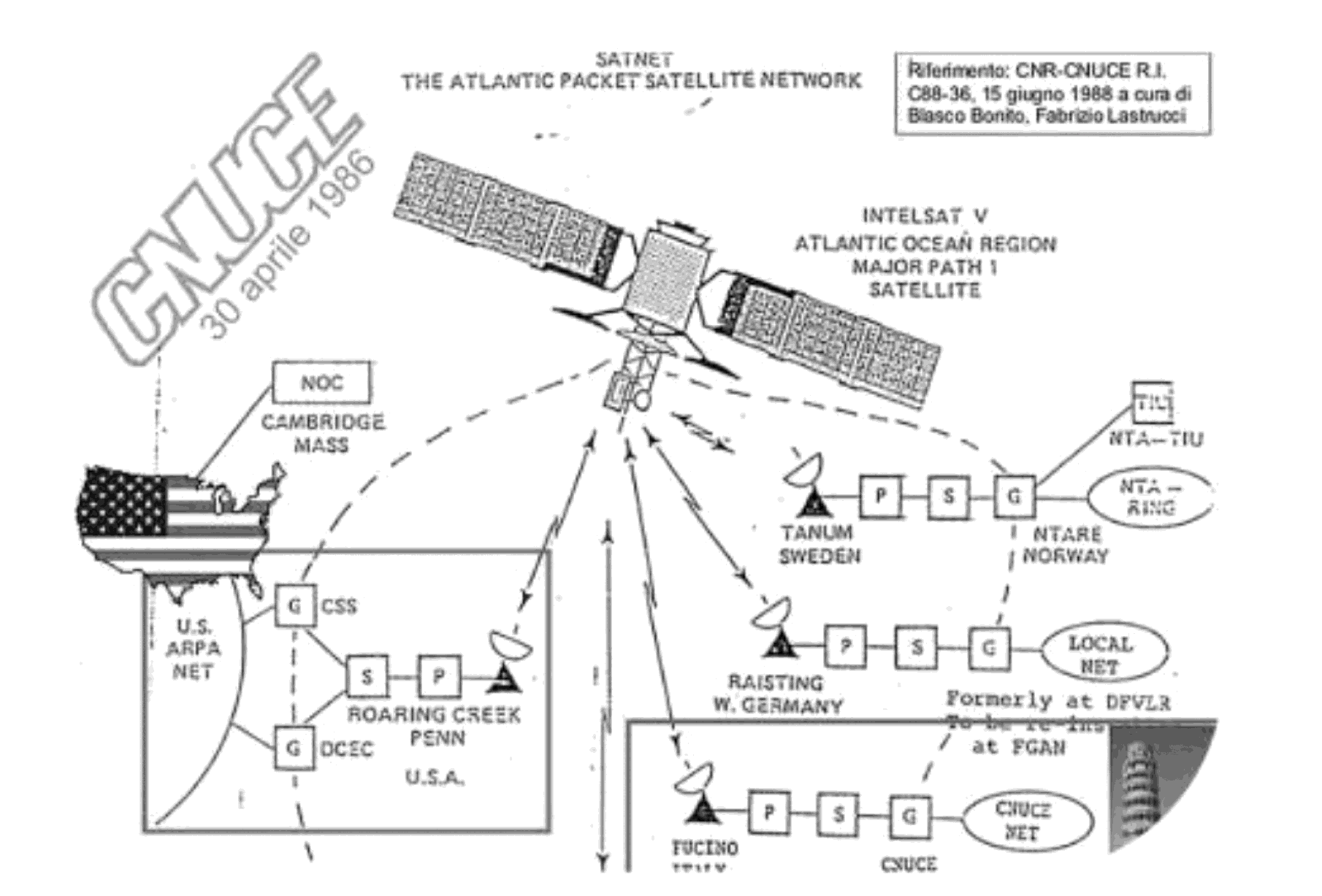
Thanks to this infrastructure, for the first time Italian researchers were able to exchange data, application software and email messages with universities and research centres overseas, joining in real time an increasingly interconnected international scientific community.

The project was carried out thanks to the vision and commitment of a group of pioneers, including Luciano Lenzini, the creator and architect of the program, Stefano Trumpy, director of CNUCE and already a key figure in the 1970s SIRIO mission, and Antonio Blasco Bonito, the technical lead of the initiative.

In 1986, the significance of this connection was not immediately understood by public opinion and received no coverage from the media. The Chernobyl disaster, which had occurred four days earlier, dominated newspapers and television news. Today, however, it is clear that this event marked the beginning of a technological revolution that would profoundly transform the economy, research and everyday life.

Forty years later, the Fucino space Centre continues to be a strategic infrastructure for satellite communications and the development of advanced space services, confirming the leadership of Telespazio and the Leonardo Group in the field of technological innovation.

To learn more about this extraordinary chapter in the history of Italian innovation, watch the documentary “Login – The Day Italy Discovered the Internet”, conceived by journalist Riccardo Luna and directed by Alice Tomassini. Released in 2016, the documentary retraces the story of that first connection through archival footage and the testimonies of the people who made it possible.

Other News & Stories

15.09.2026
FLEX and Sentinel-3C in Orbit: Leonardo and Telespazio's Contribution to ESA's Earth Observation Missions

On September 15th 2026, at 03:21 Italian time, the FLEX and Copernicus Sentinel-3C satellites of the European Space Agency (ESA) successfully launched from Europe's Spaceport in Kourou, French Guiana. Both travelled aboard the same launcher, Avio's Vega-C, and are now flying in tandem orbit, spaced roughly ten seconds apart, at an altitude of around 800 kilometres.

28.08.2026
MTG-I2 successfully launched: Telespazio acquired the first signal from the third Meteosat Third Generation satellite from the Fucino Space Centre

MTG-I2, the third Meteosat Third Generation satellite from ESA and EUMETSAT, lifted off yesterday, 27 August, at 20:11 UTC from the Kourou spaceport in French Guiana, aboard an Arianespace Ariane 6 launcher. About 25 minutes after launch, Telespazio's Fucino Space Centre — a Leonardo Group subsidiary — acquired the satellite's first signal, officially marking the start of the LEOP (Launch and Early Orbit Phase), which will last twelve days.

30.07.2026
Italy-France: the Fucino Space Centre welcomes the institutional visit of Ministers Urso and Baptiste

The Minister of Enterprises and Made in Italy and Delegated Authority for Space and Aerospace Policies, Sen. Adolfo Urso, and France's Minister for Higher Education, Research and Space, Philippe Baptiste, today visited Telespazio's Fucino Space Centre, in the presence of Marco Marsilio, President of the Abruzzo Region, as part of an initiative organized by Leonardo and Telespazio.

09.07.2026
Telespazio successfully completes an important milestone for the upgrade of ASI's Sardinia Deep Space Antenna

The Sardinia Deep Space Antenna of the Italian Space Agency (ASI) is taking a decisive step toward becoming a strategic asset for Deep Space and Near Earth missions. Telespazio (Leonardo Group) has successfully completed the final milestone "EMM Delivery M4," achieving 100% of the objectives set for the activities entrusted by ASI as part of the Earth, Moon and Mars (EMM) project, funded by the Ministry of University and Research through PNRR (National Recovery and Resilience Plan) funds.

15.09.2026
FLEX and Sentinel-3C in Orbit: Leonardo and Telespazio's Contribution to ESA's Earth Observation Missions

On September 15th 2026, at 03:21 Italian time, the FLEX and Copernicus Sentinel-3C satellites of the European Space Agency (ESA) successfully launched from Europe's Spaceport in Kourou, French Guiana. Both travelled aboard the same launcher, Avio's Vega-C, and are now flying in tandem orbit, spaced roughly ten seconds apart, at an altitude of around 800 kilometres.

28.08.2026
MTG-I2 successfully launched: Telespazio acquired the first signal from the third Meteosat Third Generation satellite from the Fucino Space Centre

MTG-I2, the third Meteosat Third Generation satellite from ESA and EUMETSAT, lifted off yesterday, 27 August, at 20:11 UTC from the Kourou spaceport in French Guiana, aboard an Arianespace Ariane 6 launcher. About 25 minutes after launch, Telespazio's Fucino Space Centre — a Leonardo Group subsidiary — acquired the satellite's first signal, officially marking the start of the LEOP (Launch and Early Orbit Phase), which will last twelve days.

30.07.2026
Italy-France: the Fucino Space Centre welcomes the institutional visit of Ministers Urso and Baptiste

The Minister of Enterprises and Made in Italy and Delegated Authority for Space and Aerospace Policies, Sen. Adolfo Urso, and France's Minister for Higher Education, Research and Space, Philippe Baptiste, today visited Telespazio's Fucino Space Centre, in the presence of Marco Marsilio, President of the Abruzzo Region, as part of an initiative organized by Leonardo and Telespazio.

09.07.2026
Telespazio successfully completes an important milestone for the upgrade of ASI's Sardinia Deep Space Antenna

The Sardinia Deep Space Antenna of the Italian Space Agency (ASI) is taking a decisive step toward becoming a strategic asset for Deep Space and Near Earth missions. Telespazio (Leonardo Group) has successfully completed the final milestone "EMM Delivery M4," achieving 100% of the objectives set for the activities entrusted by ASI as part of the Earth, Moon and Mars (EMM) project, funded by the Ministry of University and Research through PNRR (National Recovery and Resilience Plan) funds.