

Sentinels to protect our Planet: the Copernicus era begins

In 2014, one of the most ambitious European programs ever kicks off. The new episode of the cycle "A Space Story".

12 July 2021

A shift in perspective, much like the one that led Nicolaus Copernicus to enunciate his heliocentric model in 1543.

When Sentinel-1A lifted off from the launch pad of the European spaceport of Kourou in French Guiana, it was already clear that the Copernicus programme, coordinated by the European Commission, would represent a breakthrough in the fight to protect the Earth.

That infrastructure that, just as happened with Galileo, did not belong to any state but to the European Union as a whole. 

Six families of satellites, "Sentinels" in fact, with the aim of studying the planet, monitor the most fragile areas such as seas and glaciers, obtain data on changes taking place and allow timely interventions in case of emergencies. No country has ever realized an Earth observation program so ambitious and complete.

Artist view of Sentinel-1 (Credits: ESA)

Telespazio stands out as one of the main industrial partners of the program.

The company contributes to the development of the ground segment and operations; it operates (through its subsidiaries e-GEOSGAF and Telespazio UK) in emergency management, land and maritime security, land resource management and climate change monitoring; it provides the Copernicus program with Earth observation data from the COSMO-SkyMed and IRS missions.

In particular, since 2012 the e-GEOS Matera Space Center is one of the three stations of the Copernicus Core Ground Segment and receives radar and optical data acquired by the Sentinel-1 and Sentinel-2 missions.
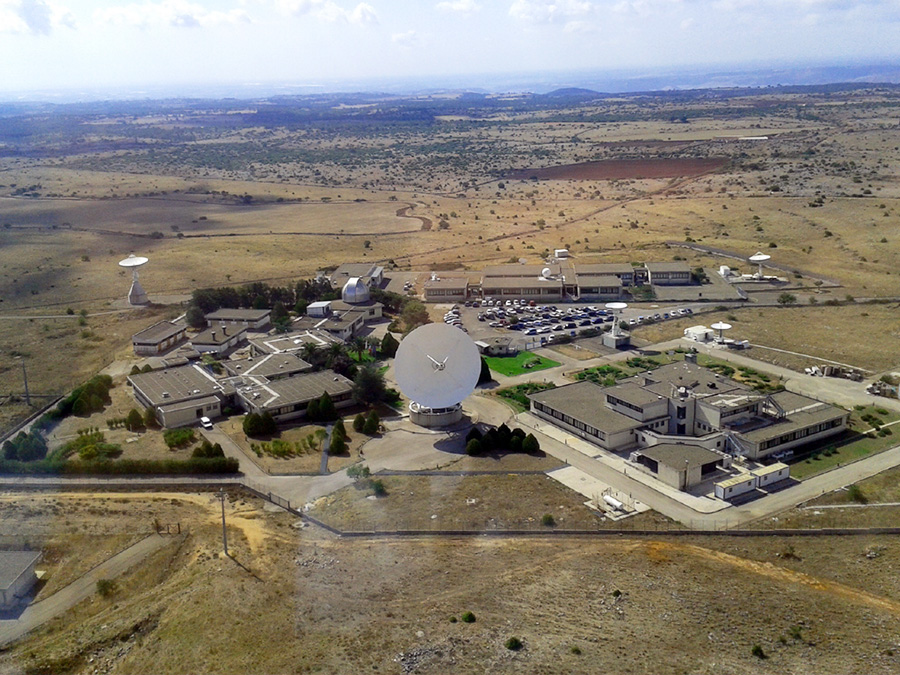
An aerial view of the Matera Space Center.

Today, the data from the Copernicus constellation are essential to the construction of the Digital Twin Earth, a predictive model that thanks to artificial intelligence and machine learning will be able to prevent natural disasters and assess the impact of environmental policies even before they are implemented.

The next step towards a sustainable future.

Other News & Stories

17.12.2025
Two New Galileo Satellites Successfully Launched

Two new first-generation Galileo satellites, numbers 33 and 34, were successfully launched today aboard an Ariane 6 launcher at 06:01 (CET) Italian time from Europe’s Spaceport in Kourou, French Guiana. Galileo is Europe’s global satellite navigation system, developed by the European Union with the technical and industrial support of the European Space Agency (ESA).

16.12.2025
Love Planet Earth 2026: the Calendar by Leonardo, e-GEOS, Telespazio and Med-Or Italian Foundation on agriculture in the Mediterranean

On the occasion of 2025 Italian National Space Day, Leonardo, with e-GEOS (a joint venture 20% owned by the Italian Space Agency and 80% by Telespazio, Leonardo Group) and Telespazio (67% owned by Leonardo and 33% by Thales) present the eighteenth "Love Planet Earth" calendar, representing environmental sustainability through images taken by the COSMO-SkyMed satellites operated by the Italian Space Agency and the Italian Ministry of Defence.

11.12.2025
Leonardo, Telespazio and Intuitive Machines sign a strategic agreement for lunar communication and navigation

Leonardo, Telespazio and Intuitive Machines have signed a strategic cooperation agreement to develop interoperable infrastructures and provide communications and navigation services in support of lunar exploration.

13.11.2025
Agritech Living Lab: Telespazio at the forefront of agricultural innovation

Telespazio hosted the Agritech Living Lab at the Fucino Space Centre, an event organized within the framework of the Agritech Project, funded by the Italian Ministry of University and Research (MUR) under the National Recovery and Resilience Plan (NRRP), supported by the European Union’s NextGenerationEU initiative.

17.12.2025
Two New Galileo Satellites Successfully Launched

Two new first-generation Galileo satellites, numbers 33 and 34, were successfully launched today aboard an Ariane 6 launcher at 06:01 (CET) Italian time from Europe’s Spaceport in Kourou, French Guiana. Galileo is Europe’s global satellite navigation system, developed by the European Union with the technical and industrial support of the European Space Agency (ESA).

16.12.2025
Love Planet Earth 2026: the Calendar by Leonardo, e-GEOS, Telespazio and Med-Or Italian Foundation on agriculture in the Mediterranean

On the occasion of 2025 Italian National Space Day, Leonardo, with e-GEOS (a joint venture 20% owned by the Italian Space Agency and 80% by Telespazio, Leonardo Group) and Telespazio (67% owned by Leonardo and 33% by Thales) present the eighteenth "Love Planet Earth" calendar, representing environmental sustainability through images taken by the COSMO-SkyMed satellites operated by the Italian Space Agency and the Italian Ministry of Defence.

11.12.2025
Leonardo, Telespazio and Intuitive Machines sign a strategic agreement for lunar communication and navigation

Leonardo, Telespazio and Intuitive Machines have signed a strategic cooperation agreement to develop interoperable infrastructures and provide communications and navigation services in support of lunar exploration.

13.11.2025
Agritech Living Lab: Telespazio at the forefront of agricultural innovation

Telespazio hosted the Agritech Living Lab at the Fucino Space Centre, an event organized within the framework of the Agritech Project, funded by the Italian Ministry of University and Research (MUR) under the National Recovery and Resilience Plan (NRRP), supported by the European Union’s NextGenerationEU initiative.