

Sentinels to protect our Planet: the Copernicus era begins

In 2014, one of the most ambitious European programs ever kicks off. The new episode of the cycle "A Space Story".

12 July 2021

A shift in perspective, much like the one that led Nicolaus Copernicus to enunciate his heliocentric model in 1543.

When Sentinel-1A lifted off from the launch pad of the European spaceport of Kourou in French Guiana, it was already clear that the Copernicus programme, coordinated by the European Commission, would represent a breakthrough in the fight to protect the Earth.

That infrastructure that, just as happened with Galileo, did not belong to any state but to the European Union as a whole. 

Six families of satellites, "Sentinels" in fact, with the aim of studying the planet, monitor the most fragile areas such as seas and glaciers, obtain data on changes taking place and allow timely interventions in case of emergencies. No country has ever realized an Earth observation program so ambitious and complete.

Artist view of Sentinel-1 (Credits: ESA)

Telespazio stands out as one of the main industrial partners of the program.

The company contributes to the development of the ground segment and operations; it operates (through its subsidiaries e-GEOSGAF and Telespazio UK) in emergency management, land and maritime security, land resource management and climate change monitoring; it provides the Copernicus program with Earth observation data from the COSMO-SkyMed and IRS missions.

In particular, since 2012 the e-GEOS Matera Space Center is one of the three stations of the Copernicus Core Ground Segment and receives radar and optical data acquired by the Sentinel-1 and Sentinel-2 missions.
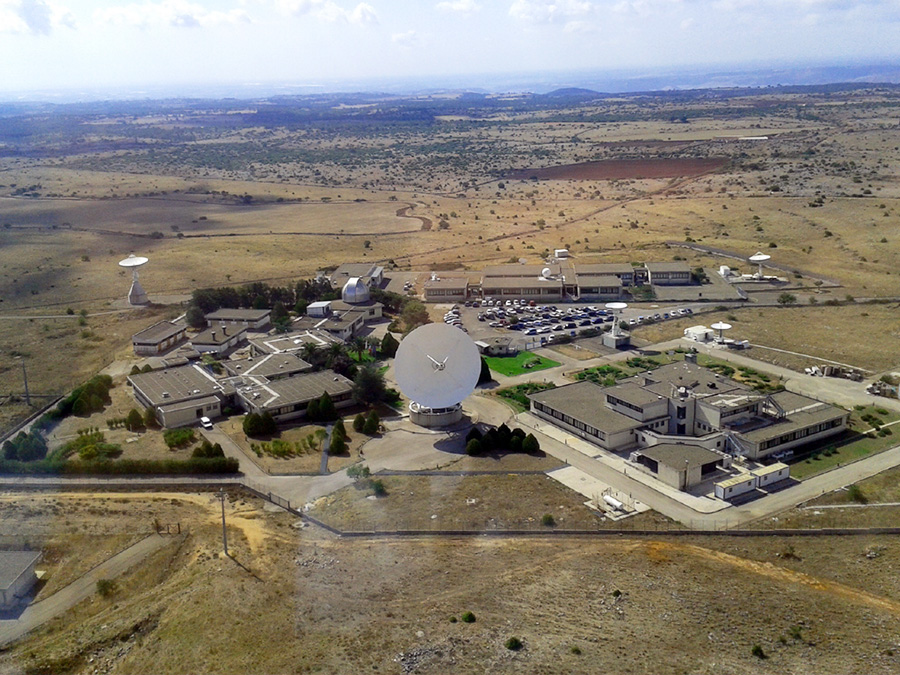
An aerial view of the Matera Space Center.

Today, the data from the Copernicus constellation are essential to the construction of the Digital Twin Earth, a predictive model that thanks to artificial intelligence and machine learning will be able to prevent natural disasters and assess the impact of environmental policies even before they are implemented.

The next step towards a sustainable future.

Other News & Stories

28.08.2026
MTG-I2 successfully launched: Telespazio acquired the first signal from the third Meteosat Third Generation satellite from the Fucino Space Centre

MTG-I2, the third Meteosat Third Generation satellite from ESA and EUMETSAT, lifted off yesterday, 27 August, at 20:11 UTC from the Kourou spaceport in French Guiana, aboard an Arianespace Ariane 6 launcher. About 25 minutes after launch, Telespazio's Fucino Space Centre — a Leonardo Group subsidiary — acquired the satellite's first signal, officially marking the start of the LEOP (Launch and Early Orbit Phase), which will last twelve days.

30.07.2026
Italy-France: the Fucino Space Centre welcomes the institutional visit of Ministers Urso and Baptiste

The Minister of Enterprises and Made in Italy and Delegated Authority for Space and Aerospace Policies, Sen. Adolfo Urso, and France's Minister for Higher Education, Research and Space, Philippe Baptiste, today visited Telespazio's Fucino Space Centre, in the presence of Marco Marsilio, President of the Abruzzo Region, as part of an initiative organized by Leonardo and Telespazio.

09.07.2026
Telespazio successfully completes an important milestone for the upgrade of ASI's Sardinia Deep Space Antenna

The Sardinia Deep Space Antenna of the Italian Space Agency (ASI) is taking a decisive step toward becoming a strategic asset for Deep Space and Near Earth missions. Telespazio (Leonardo Group) has successfully completed the final milestone "EMM Delivery M4," achieving 100% of the objectives set for the activities entrusted by ASI as part of the Earth, Moon and Mars (EMM) project, funded by the Ministry of University and Research through PNRR (National Recovery and Resilience Plan) funds.

23.06.2026
Telespazio and CEiiA join forces in the Iberian space sector

Earth Observation, satellite constellations, space operations: Telespazio Iberica and CEiiA, an engineering and product development centre based in Portugal, are joining forces through a Letter of Intent aimed at strengthening the Iberian space ecosystem.

28.08.2026
MTG-I2 successfully launched: Telespazio acquired the first signal from the third Meteosat Third Generation satellite from the Fucino Space Centre

MTG-I2, the third Meteosat Third Generation satellite from ESA and EUMETSAT, lifted off yesterday, 27 August, at 20:11 UTC from the Kourou spaceport in French Guiana, aboard an Arianespace Ariane 6 launcher. About 25 minutes after launch, Telespazio's Fucino Space Centre — a Leonardo Group subsidiary — acquired the satellite's first signal, officially marking the start of the LEOP (Launch and Early Orbit Phase), which will last twelve days.

30.07.2026
Italy-France: the Fucino Space Centre welcomes the institutional visit of Ministers Urso and Baptiste

The Minister of Enterprises and Made in Italy and Delegated Authority for Space and Aerospace Policies, Sen. Adolfo Urso, and France's Minister for Higher Education, Research and Space, Philippe Baptiste, today visited Telespazio's Fucino Space Centre, in the presence of Marco Marsilio, President of the Abruzzo Region, as part of an initiative organized by Leonardo and Telespazio.

09.07.2026
Telespazio successfully completes an important milestone for the upgrade of ASI's Sardinia Deep Space Antenna

The Sardinia Deep Space Antenna of the Italian Space Agency (ASI) is taking a decisive step toward becoming a strategic asset for Deep Space and Near Earth missions. Telespazio (Leonardo Group) has successfully completed the final milestone "EMM Delivery M4," achieving 100% of the objectives set for the activities entrusted by ASI as part of the Earth, Moon and Mars (EMM) project, funded by the Ministry of University and Research through PNRR (National Recovery and Resilience Plan) funds.

23.06.2026
Telespazio and CEiiA join forces in the Iberian space sector

Earth Observation, satellite constellations, space operations: Telespazio Iberica and CEiiA, an engineering and product development centre based in Portugal, are joining forces through a Letter of Intent aimed at strengthening the Iberian space ecosystem.