

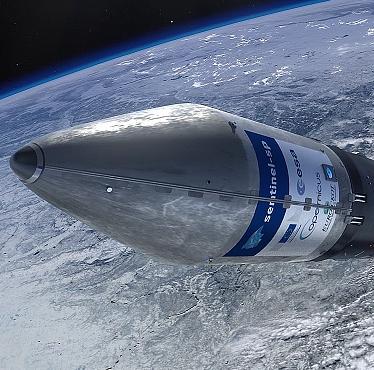
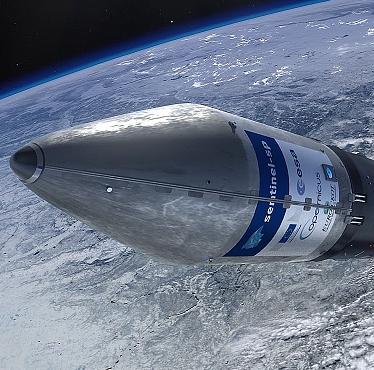
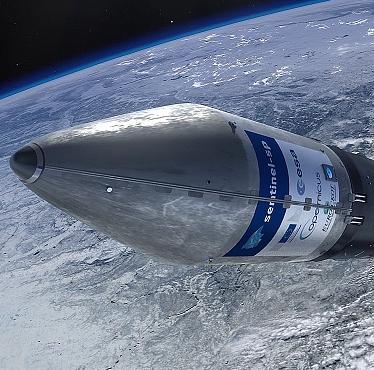
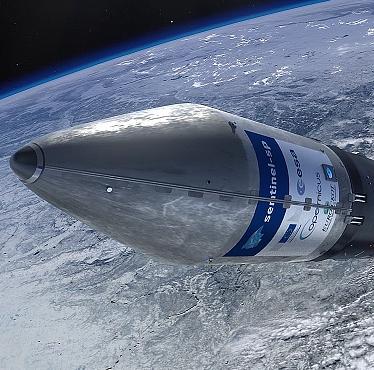
Copernicus: Sentinel-5p satellite launched successfully. Set to monitor the Earth's atmosphere conditions

Plesetsk Cosmodrome (Russia)  13 October 2017

The Sentinel-5P satellite - part of the ESA’s Copernicus Earth observation programme - was launched successfully today at 9:27 GMT (11:27 CET) from the Plesetsk Cosmodrome in Russia, using a Rockot carrier.

This is the first Copernicus mission dedicated to monitoring the atmosphere. The information gathered by the Sentinel-5P will be used through the Copernicus Atmosphere Monitoring Service to forecast the quality of the air and for decision-making processes.

The Sentinel-5P will join another five ESA Sentinels put into orbit since 2014.

Since 2013, Telespazio, along with its subsidiary Telespazio VEGA Deutschland, has played its part in preparing the Sentinel-5P mission as part of the contract awarded to it by the ESOC (ESA’s European Space Operations Centre). Telespazio VEGA Deutschland provided a vast array of services: from operations and engineering, to flight dynamics and ICT (network engineering, IT coordination and data systems).

Telespazio is one of the leading industrial partners in Copernicus, a programme coordinated and run by the European Commission, in order to provide Europe with its own Earth observation capacity. The Company has been and continues to be involved in the creation, maintenance, and evolution of the Payload Data Ground Segments (PDGS) for Sentinel-1 and Sentinel-3, the Mission Control Systems for Sentinel-1, Sentinel-2, Sentinel-3 and Sentinel-5P and the infrastructure for access to the Earth observation products the Copernicus missions (Copernicus Space Component Data Access – Coordinated Data Access System – CSCDA/CDS).

Within the Copernicus Operations sector, Telespazio’s staff supports to the ESOC during pre- and post-launch phases for the Sentinel satellites, and is responsible for CSCDA/CDS operations, as well as for acquiring data from the Sentinel-1 and Sentinel-2 missions, from the e-GEOS Space Centre in Matera. In addition, as the main contractor, it will be responsible for managing the end-to-end service for the operations until 2021, and for maintenance and evolution of the entire earth segment of the Sentinel-3 mission. Moreover, it supports AIRBUS in its operational activities for the entire earth segment of the Sentinel-1 mission.

In the Copernicus Services sector, Telespazio engages in the activities related to the management of emergencies, land and maritime safety, management of ground resources, and the monitoring climate changes. In fact, the Matera Space Centre is one of three Core Ground Segment stations for the Copernicus programme, and receives radar and optical data acquired by the Sentinel-1 and Sentinel-2 missions.

Finally, Telespazio provides earth observation data obtained from the COSMO-SkyMed and IRS missions to the Copernicus programme.

Other News & Stories

06.05.2026
Greenerwave and Telespazio France sign strategic agreement to distribute multi-orbit, low-power and sovereign satcom terminals in europe

Telespazio France, a Leonardo group company, and Greenerwave, a French deeptech company, announce the signing of a strategic agreement aimed at deploying and distributing Greenerwave’s multi-orbit, energy-efficient and sovereign SATCOM terminals across the European defense and government markets.

05.05.2026
Open Innovation in the space sector: Leonardo and Telespazio honour the winners of the seven edition of #T-Tec

The award ceremony for the seventh edition of #T-TeC was held today in Rome, at the headquarters of the Italian Space Agency (ASI). The contest is an Open Innovation competition organised by Leonardo and Telespazio to foster technological innovation in the space sector among the younger generation of students and researchers from universities around the world.

30.04.2026
40 years ago, Italy’s first connection to the Internet thanks to the antennas of the Fucino space Centre

On April 30, 1986, Italy joined the global network that in the following years would become the Internet for the first time. The connection was made possible thanks to the key role of the Fucino space Centre, whose antennas carried the signal that connected the country with the United States.

02.04.2026
New Generation Builders: Space Division’s Development program

The final event of the “New Generation Builders – Where Ideas Meet Purpose” program took place on March 10 at the Acquario Romano. The initiative brought together 80 colleagues from across the Space Division: Leonardo, Telespazio, and e-GEOS.

06.05.2026
Greenerwave and Telespazio France sign strategic agreement to distribute multi-orbit, low-power and sovereign satcom terminals in europe

Telespazio France, a Leonardo group company, and Greenerwave, a French deeptech company, announce the signing of a strategic agreement aimed at deploying and distributing Greenerwave’s multi-orbit, energy-efficient and sovereign SATCOM terminals across the European defense and government markets.

05.05.2026
Open Innovation in the space sector: Leonardo and Telespazio honour the winners of the seven edition of #T-Tec

The award ceremony for the seventh edition of #T-TeC was held today in Rome, at the headquarters of the Italian Space Agency (ASI). The contest is an Open Innovation competition organised by Leonardo and Telespazio to foster technological innovation in the space sector among the younger generation of students and researchers from universities around the world.

30.04.2026
40 years ago, Italy’s first connection to the Internet thanks to the antennas of the Fucino space Centre

On April 30, 1986, Italy joined the global network that in the following years would become the Internet for the first time. The connection was made possible thanks to the key role of the Fucino space Centre, whose antennas carried the signal that connected the country with the United States.

02.04.2026
New Generation Builders: Space Division’s Development program

The final event of the “New Generation Builders – Where Ideas Meet Purpose” program took place on March 10 at the Acquario Romano. The initiative brought together 80 colleagues from across the Space Division: Leonardo, Telespazio, and e-GEOS.