

Telespazio Communicates with the Moon

29 May 2026

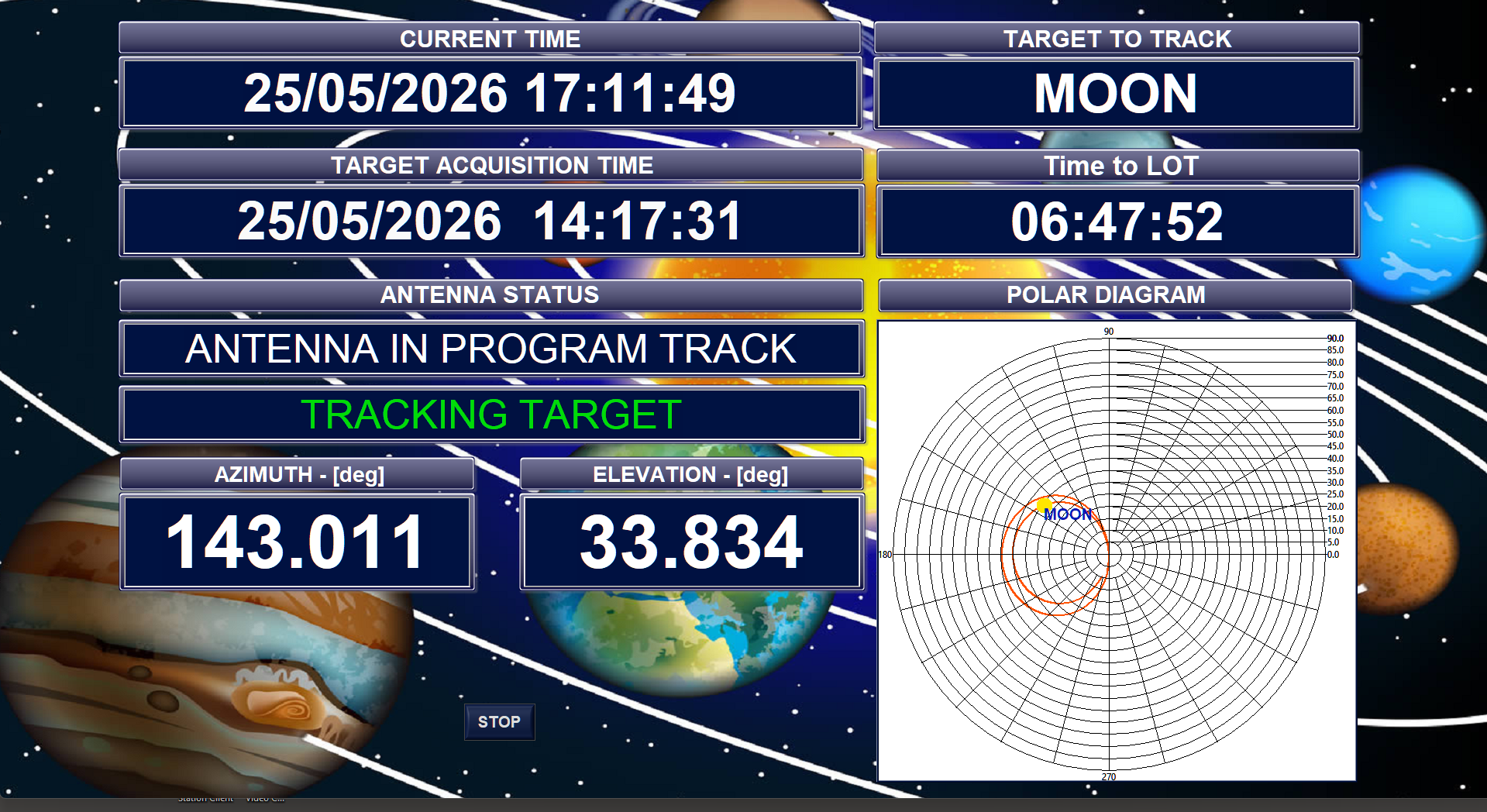
Telespazio, a Leonardo Group company, carried out a Moon-Bounce experiment on 25 May, consisting of the transmission of a radio signal from an antenna at its Lario Space Centre, in the province of Como, towards the lunar surface. The signal, reflected by our natural satellite, was sent back towards Earth and received by the Fucino Space Centre in Abruzzo, and potentially by any antenna in line-of-sight of the Moon at that moment.

Earth–Moon–Earth (EME) communication, also known as “Moon-bounce”, is a radio communication technique based on the propagation of radio waves emitted by a ground transmitter, which are reflected off the lunar surface and returned to a ground receiver. The average distance between the Earth and the Moon is approximately 384,000 km.

The experiment, carried out by Telespazio technicians using a parabolic antenna at the Lario Space Centre that routinely communicates with satellites in geostationary orbit approximately 36,000 kilometres from Earth, demonstrated the technical capabilities of the Italian site in the fields of radio-astronomical communication and space experimentation.

The antenna used, named LARIO 1, has a diameter of 32 metres and is equipped with a movement system enabling it to perform pointing, tracking, and tracing operations of artificial satellites, planets, and galaxies visible from the Lombardy teleport.

This type of experimentation is part of a context in which Telespazio, together with the broader contribution of Leonardo, plays a leading role. The company is indeed the prime contractor for the European Space Agency's (ESA) Moonlight programme, aimed at building a communication and navigation infrastructure in lunar orbit, the first system of its kind. In October 2024, Telespazio signed the LCNS (Lunar Communication and Navigation Services) contract with ESA, leading a European consortium that includes industrial and academic partners. The system, which envisages a constellation of five satellites in cislunar orbit, will support future human and robotic exploration missions, enabling precise lunar landings, surface navigation, and high-speed communications between the Moon and Earth. The first satellite, Lunar Pathfinder, is expected in orbit in 2027, with the system fully operational by 2031.
The bond between Telespazio and the Moon runs deep, having begun in July 1969, when a parabolic antenna at the Fucino Space Centre was among the first in Europe to receive and rebroadcast the television images of the Apollo 11 Moon landing, bringing one of the most extraordinary events in human history into the homes of Italians.

The Moon-bounce experiment took place during the closing event of the second edition of the “There’s Mail for E.T.” competition organised by the Italian National Institute for Astrophysics (INAF), under the patronage of the University of Urbino Carlo Bo, DIGIT srl, AMSAT Italia, and the Department of Industrial and Information Engineering and Economics (DIIIE) of the University of L’Aquila.

Other News & Stories

25.09.2026
Fucino Space Centre: from the first "ping" to the future of the Internet

Prof. Luciano Lenzini, a pioneer in bringing the Internet to Italy, met with Telespazio engineers and technicians at the Fucino Space Centre, through which the first Internet link between Italy and the United States passed 40 years ago.

21.09.2026
Connectivity: results of the satellite trial in Lombardy presented in Milan

Connecting entire villages to the national network through an infrastructure that combines satellite, fiber and wireless connections, in order to bring quality digital services even to the hardest-to-reach areas. This is the goal of the trial carried out in Lombardy, whose preliminary results were presented at the Milan office of the Department for Digital Transformation. Telespazio took part in the initiative by developing a proprietary backhauling solution that aggregates multiple satellite links.

15.09.2026
FLEX and Sentinel-3C in Orbit: Leonardo and Telespazio's Contribution to ESA's Earth Observation Missions

On September 15th 2026, at 03:21 Italian time, the FLEX and Copernicus Sentinel-3C satellites of the European Space Agency (ESA) successfully launched from Europe's Spaceport in Kourou, French Guiana. Both travelled aboard the same launcher, Avio's Vega-C, and are now flying in tandem orbit, spaced roughly ten seconds apart, at an altitude of around 800 kilometres.

28.08.2026
MTG-I2 successfully launched: Telespazio acquired the first signal from the third Meteosat Third Generation satellite from the Fucino Space Centre

MTG-I2, the third Meteosat Third Generation satellite from ESA and EUMETSAT, lifted off yesterday, 27 August, at 20:11 UTC from the Kourou spaceport in French Guiana, aboard an Arianespace Ariane 6 launcher. About 25 minutes after launch, Telespazio's Fucino Space Centre — a Leonardo Group subsidiary — acquired the satellite's first signal, officially marking the start of the LEOP (Launch and Early Orbit Phase), which will last twelve days.

25.09.2026
Fucino Space Centre: from the first "ping" to the future of the Internet

Prof. Luciano Lenzini, a pioneer in bringing the Internet to Italy, met with Telespazio engineers and technicians at the Fucino Space Centre, through which the first Internet link between Italy and the United States passed 40 years ago.

21.09.2026
Connectivity: results of the satellite trial in Lombardy presented in Milan

Connecting entire villages to the national network through an infrastructure that combines satellite, fiber and wireless connections, in order to bring quality digital services even to the hardest-to-reach areas. This is the goal of the trial carried out in Lombardy, whose preliminary results were presented at the Milan office of the Department for Digital Transformation. Telespazio took part in the initiative by developing a proprietary backhauling solution that aggregates multiple satellite links.

15.09.2026
FLEX and Sentinel-3C in Orbit: Leonardo and Telespazio's Contribution to ESA's Earth Observation Missions

On September 15th 2026, at 03:21 Italian time, the FLEX and Copernicus Sentinel-3C satellites of the European Space Agency (ESA) successfully launched from Europe's Spaceport in Kourou, French Guiana. Both travelled aboard the same launcher, Avio's Vega-C, and are now flying in tandem orbit, spaced roughly ten seconds apart, at an altitude of around 800 kilometres.

28.08.2026
MTG-I2 successfully launched: Telespazio acquired the first signal from the third Meteosat Third Generation satellite from the Fucino Space Centre

MTG-I2, the third Meteosat Third Generation satellite from ESA and EUMETSAT, lifted off yesterday, 27 August, at 20:11 UTC from the Kourou spaceport in French Guiana, aboard an Arianespace Ariane 6 launcher. About 25 minutes after launch, Telespazio's Fucino Space Centre — a Leonardo Group subsidiary — acquired the satellite's first signal, officially marking the start of the LEOP (Launch and Early Orbit Phase), which will last twelve days.