
IRIDE
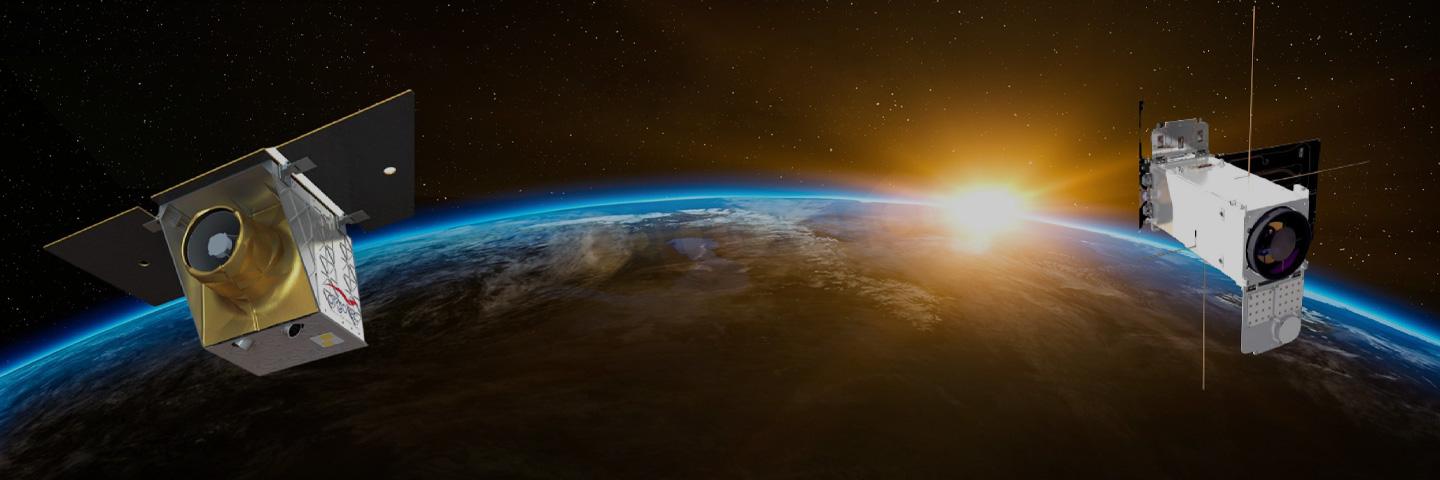
IRIDE is an Earth observation satellite constellation that originated as an initiative of the Italian Government, supported by funding from the National Recovery and Resilience Plan (PNRR). Developed by the European Space Agency (ESA) with the support of the Italian Space Agency (ASI), IRIDE is owned by ASI.
The programme is funded by the European Union – NextGenerationEU and by the Presidency of the Council of Ministers of the Italian Republic.

Designed as a “constellation of constellations”, IRIDE comprises several sub-constellations of satellites in low Earth orbit (LEO), known as the Upstream Segment, together with operational ground infrastructure (Downstream) and services for the Italian Public Administration (Service Segment).

Deployment in orbit is under way: 39 satellites are already in orbit, including the 24 of the Eaglet II constellation, completed with the launch of 1 October 2026, and the 15 of the HEO constellation. Launches of the NIMBUS-SAR and HEO satellites are planned for the coming months, followed by the remaining constellations.

Specifically, IRIDE involves the development, launch and operation of satellites, and the delivery of the related services, using a range of sensing technologies: Synthetic Aperture Radar (SAR) and high- and medium-resolution optical sensors operating across different frequency ranges, from panchromatic to multispectral, hyperspectral and infrared bands.

In addition to serving the Italian Public Administration, IRIDE aims to support the Civil Protection Department and other authorities in tackling hydrogeological risk and wildfires, protecting coastlines, and monitoring critical infrastructure, air quality and weather conditions.

IRIDE will also provide analytical data to support the development of commercial applications by startups, small and medium-sized enterprises and industry players.

The role of Telespazio and e-GEOS

Thanks to its expertise, Telespazio plays a key role in developing IRIDE’s ground systems and space operations and, through e-GEOS, its joint venture with ASI, in providing services. Telespazio and e-GEOS’ activities are carried out under an ESA contract for the purposes of the EO PNRR IRIDE Programme.

Telespazio leads the group of Italian companies responsible for the Flight Operations Segment (FOS) for satellites based on the PLATINO platform, built by SITAEL and equipped with Leonardo’s hyperspectral radar sensor, and on Thales Alenia Space’s NIMBUS platform, which carries both SAR and optical sensors.

The FOS is one of the core elements of the ground segment. It will provide command and control, orbit determination and collision avoidance, payload data acquisition, monitoring, and operations planning.

Telespazio is also part of the industrial team led by OHB Italia for the Eaglet II constellation, completed on 1 October 2026, and its FOS. The first IRIDE satellite, Pathfinder, a microsatellite of the HEO constellation developed by Argotec, was successfully launched in January 2025, with Telespazio supporting the Launch and Early Orbit Phase (LEOP) from the Fucino Space Centre.

e-GEOS has built IRIDE’s digital marketplace, the infrastructure for accessing data and services, which has been open to Italian institutional users since 1 July 2026. Since 1 October it has offered the first 18 geospatial services, comprising 110 products, for the Public Administration. Operational management of the Service Segment is entrusted to e-GEOS and Planetek Italia, each leading its own industrial group. The marketplace provides a single, reliable and cyber-secure access point for institutional and commercial customers, with the aim of making geoinformation services part of everyday operations.

The new platform will integrate cutting-edge technologies and open standards, and will be interoperable with other Earth observation data delivery, processing and analysis systems.

For IRIDE, e-GEOS will also contribute its expertise and services in processing, managing and analysing satellite big data, and will take part in modelling projects based on the Digital Twin Earth concept.

Finally, e-GEOS will contribute to the “Matera Space Center Lab”, which will set up a laboratory at ASI’s Matera Center to develop new skills in satellite image analysis.

Views expressed herein can in no way be taken to reflect the official opinion of the European Union/European Commission/ESA/Presidency of Council of Ministers of the Italian Republic. Views and opinion expressed are those of the author(s) only and the European Union/European Commission/ESA/Presidency of Council of Ministers of the Italian Republic cannot be held responsible for any use which may be made of the information contained therein.