


03 February 2026 11:00
From the images of the first Moon landing to supporting future lunar communications: agreement signed to upgrade the historic antenna at the Fucino Space Centre.
The Italian Space Agency (ASI) and Telespazio, a Leonardo Group company, have signed an agreement to launch the RESPONSE programme, aimed at modernising Telespazio’s FOC-1A antenna, installed and operational since 1967 at the “Piero Fanti” Fucino Space Centre in Abruzzo.
The objective of the project is to make the facility - a 27-metre-diameter parabolic antenna -compatible with Near-Earth and Deep Space communication requirements. In addition, the antenna will be able to support, among other things, future missions related to ESA’s global tracking network for missions and satellites (ESTRACK), as well as communications with the Moon. This will be achieved both through Italy’s direct contribution to NASA’s ARTEMIS programme and through ESA’s MOONLIGHT programme for lunar communications and navigation, for which Telespazio is Prime Contractor.
Beyond its strong symbolic value - the FOC-1A antenna was the one that allowed Italians to watch the Moon landing on television in 1969 - the initiative will enable Italy to rely on assets capable of delivering excellent performance to meet the service demands of the global space market.
“Thanks to the RESPONSE project, the FOC-1A antenna will support ASI’s lunar missions and those of international partners, enhancing data exchange also with deep space missions. Its geographical location will further enable the antenna to operate within a network of other European and international ground stations, ensuring continuous and reliable communications for the next ambitious exploration missions,” said Roberto Formaro, Head of ASI’s Engineering and Technology Directorate.
“With RESPONSE, Telespazio and ASI are giving new life to an infrastructure that has made the history of Italian and international satellite communications. The FOC-1A antenna, a symbol of the great space achievements of the 1960s and 1970s, is now being projected into the future to support lunar missions and deep space exploration over the coming decades. This is a concrete example of how Telespazio, together with Leonardo, is able to enhance its technological and industrial heritage, placing it at the service of Europe’s new ambitions and the global space community,” said Alessandra Farese, SVP Satellite Systems & Operations at Telespazio.
The development of adequate ground communication systems is a fundamental element for the success of current and future lunar missions. Without reliable links between the Moon and Earth, it would be impossible to control vehicles, transmit scientific data, ensure astronaut safety and coordinate operations in real time.
With humanity’s return to the Moon and the prospect of a permanent presence, communication systems will be required to transmit and receive large volumes of data, including high-resolution images, video, telemetry, scientific experiments and voice communications. In this context, lunar communications are not merely a technical support, but a true strategic infrastructure, essential to transforming the Moon into a scientific laboratory and a launchpad for the exploration of Mars and deep space.
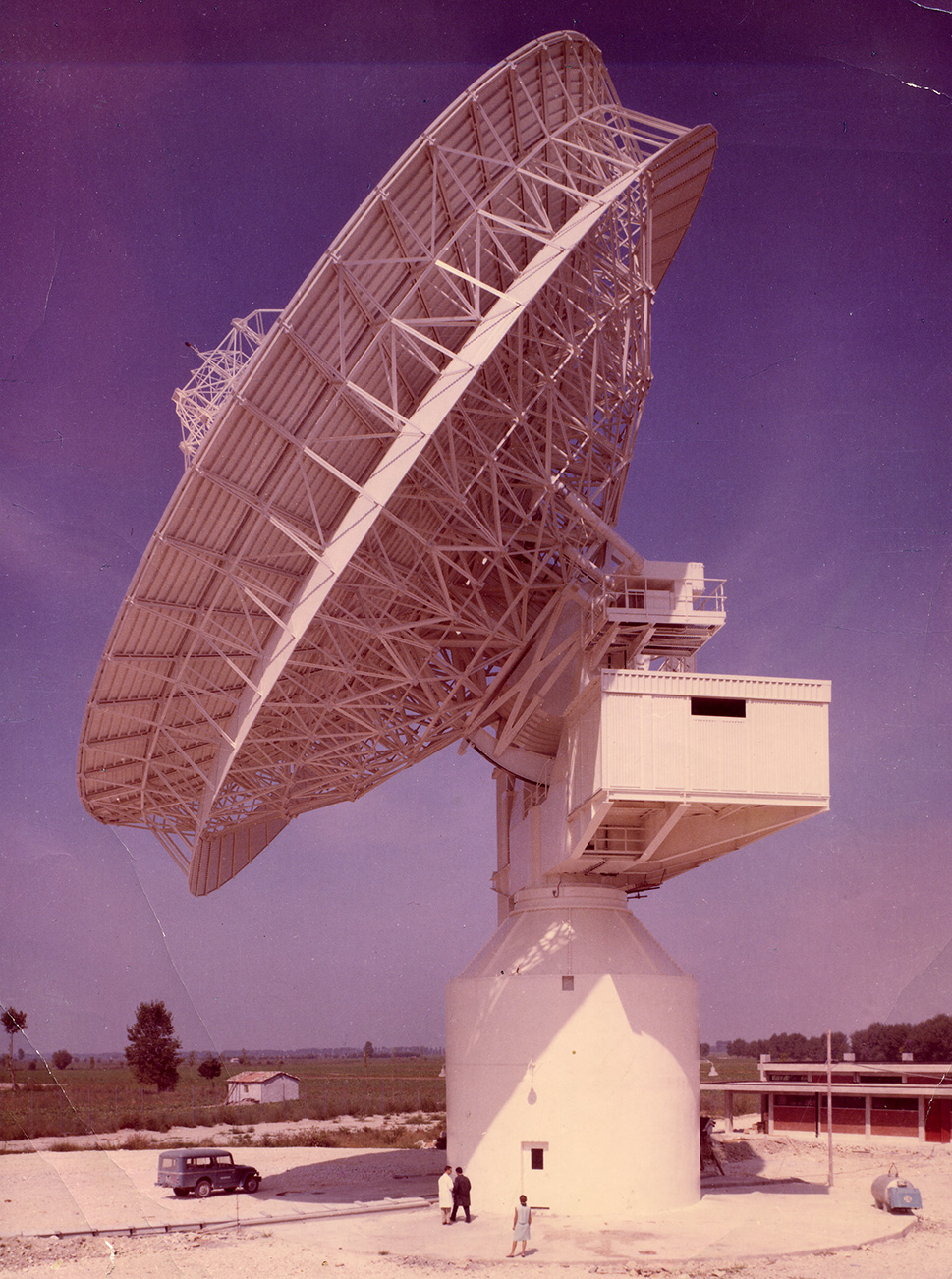
The 27-metre-diameter parabolic antenna installed in 1967 at Telespazio’s Fucino Space Centre
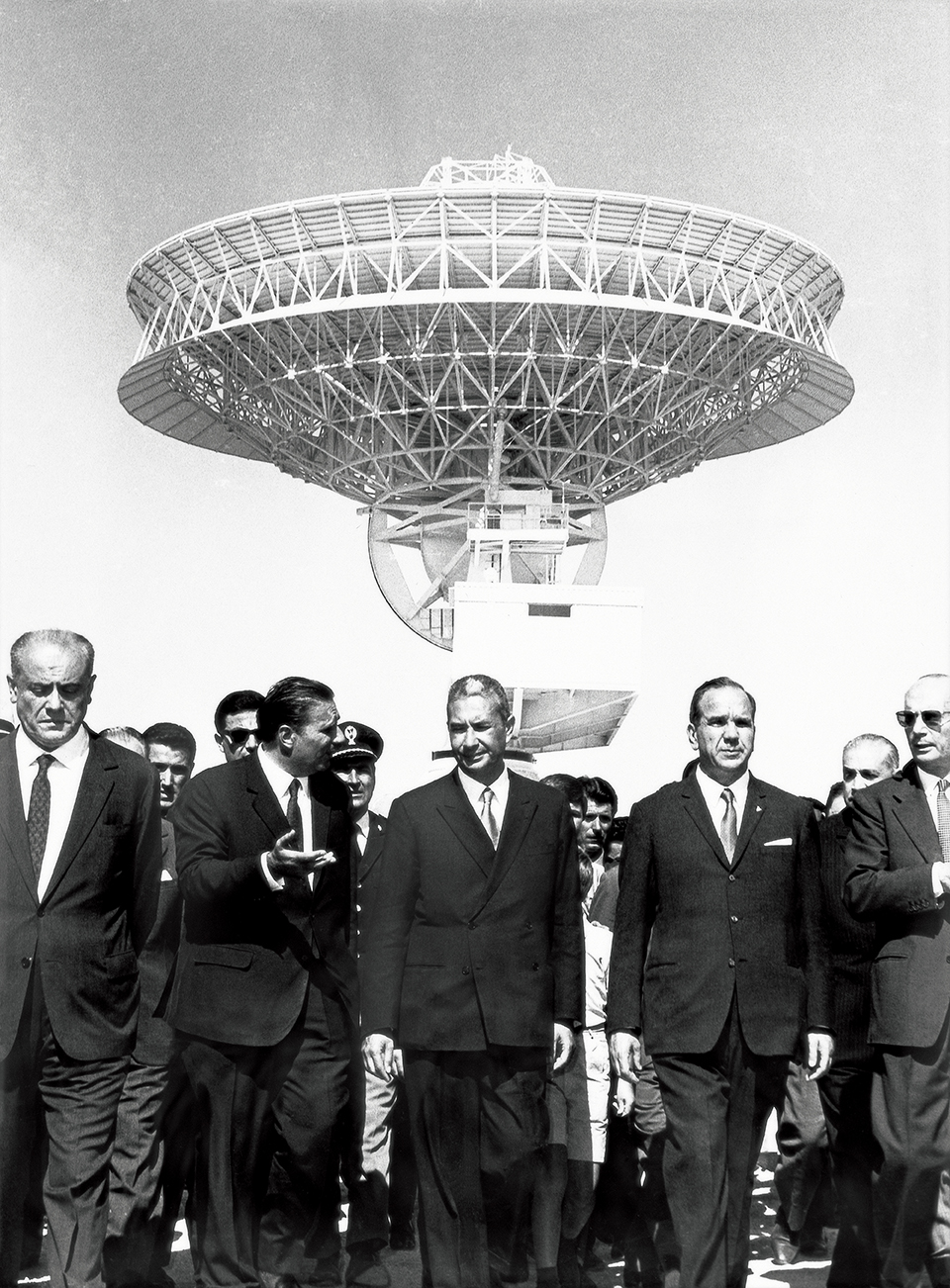
27 August 1967 - Italian Prime Minister Aldo Moro - officially inaugurates the Fucino Space Centre