

Towards the Moon and beyond: ushering in the age of global telecommunications

The year was 1969. The whole world was watching the moon landing live, while Pope Paul VI prepared for an unprecedented journey. Second episode of the “A Space Story” cycle.

11 February 2021

Anyone who didn’t own a television - and in 1969 there were still those who didn’t - flocked to their friends’, their relatives’, their neighbours’ houses. Man's first time on the Moon, his first ever on soil other than the Earth’s, was one of those events that could not be missed. In Italy, there were more than 20 million people glued in front of the TV screen; in the world, this figure reached more than 650 million. All of them holding their breath as 39-year-old Neil Armstrong climbed down the ladder of the Lunar Excursion Module (LEM), stopped on the last step, hesitated a few moments, and then jumped to the ground. And all recorded live.
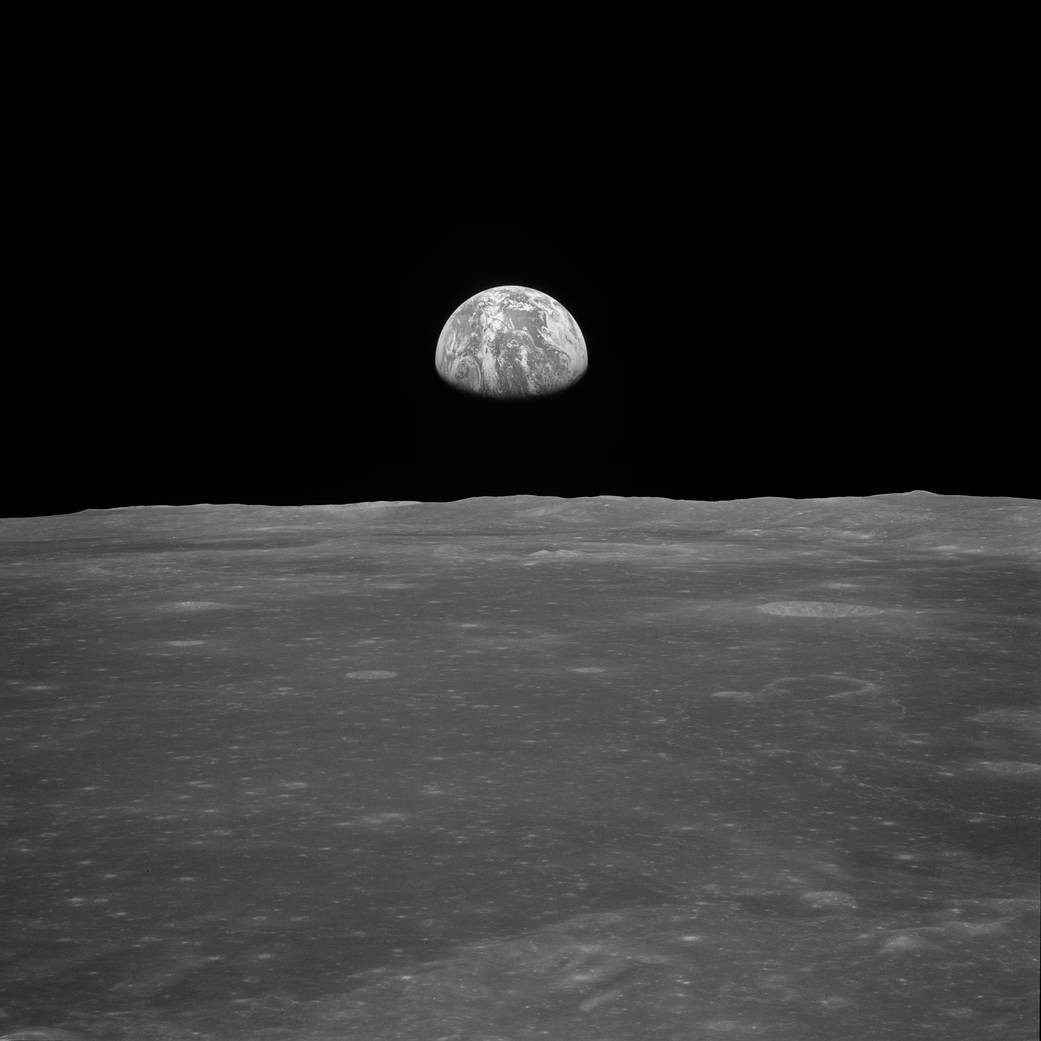
 

The Apollo 11 crew consisted of Commander Neil Armstrong, Michael Collins and Edwin “Buzz” Aldrin. Collins flew the command module and was the only crew member not to set foot on lunar soil (credits: NASA)

It was indeed a “giant leap for mankind”, but also for telecommunications.

Behind the images that reached every corner of the globe lay Early Bird, also known as Intelsat I, the first commercial satellite launched on 6 April 1965. In Europe, only four stations could receive its signals and transform them into what was to become iconic footage. One of those stations was in Italy, at the Fucino Space Centre.

Less than eight years had passed since Telespazio had been founded in 1961, but in the late sixties Fucino seemed another world. Just two years before the moon landing, on 28 August 1967, Prime Minister Aldo Moro had inaugurated Antenna B, a 27-metre parabolic dish covering the whole of the Atlantic. The small Antenna A, with which everything had started, had been successfully reused in a new business: telemetry and remote control services on Intelsat satellites.
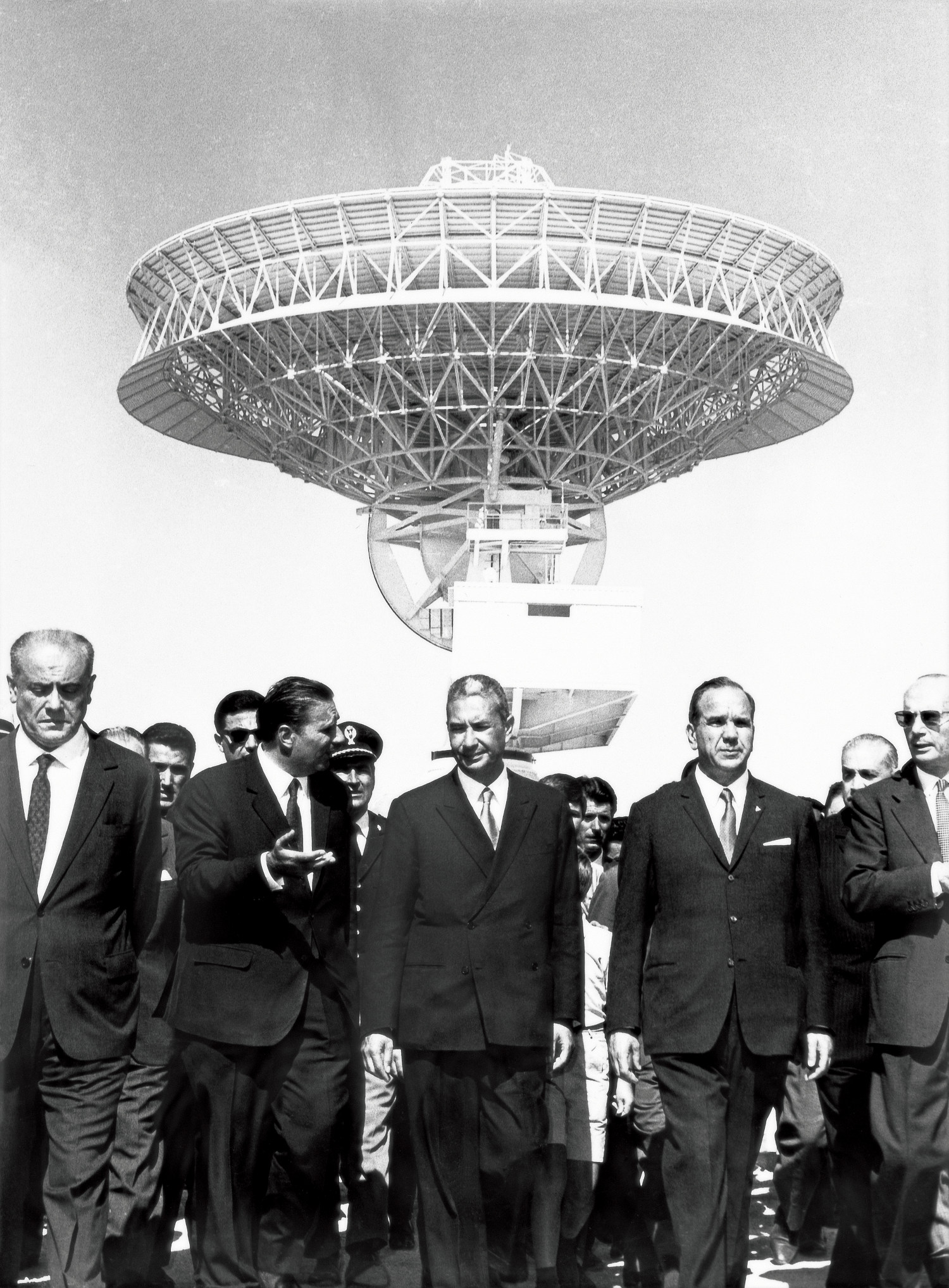
After the inauguration of the second 27-metre antenna by Aldo Moro, Piero Fanti had an idea: to use the small Antenna A to provide control and telemetry services to Intelsat. The project was approved in July 1967.

July 1969 was to be a key month for the Italian company. On the 29th, less than ten days after the lunar landing of Apollo 11, Telespazio broadcast another unprecedented event worldwide: Paul VI became the first reigning Pope to ever visit Africa. Thanks to an 8-metre diameter dish brought to Kampala by sea, the whole world was able to follow Paul VI’s visit to Uganda. The world had never been so small.

Other News & Stories

09.10.2026
Telespazio Benelux to build the ground infrastructure for ESA’s lunar ice-hunting mission

Telespazio Benelux will lead a European consortium, with EarthLab Luxembourg and Astro42, to deliver and operate the control centre for PROSPECT, ESA’s mission to drill for water ice and other volatile chemicals at the lunar south pole, with a drill developed and built by Leonardo.

08.10.2026
e-GEOS: Board of Directors appoints Cristina Sgubin as Chief Executive Officer

The Board of Directors of e-GEOS, a joint venture between Telespazio (80%) and the Italian Space Agency (20%), has unanimously appointed Attorney Cristina Sgubin as Chief Executive Officer of the company. Sgubin will also be responsible for Telespazio’s Geo Information Line of Business.

06.10.2026
ispace, Leonardo and Telespazio Sign Memorandum of Understanding to Collaborate on Lunar Exploration
  • The MoU builds on existing cooperation between ispace and Telespazio further expanding the areas of potential cooperation also leveraging on Leonardo space capabilities in robotics and AI applied to space exploration, strengthening Europe’s and Japan roles in the emerging cislunar economy.

  • The partnership will advance interoperability of lunar infrastructure and services to support global lunar exploration and explore ispace’s lunar transportation capabilities, with the European Space Agency’s Moonlight programme led by Telespazio, part of Leonardo Group, being the first opportunity to implement it.

25.09.2026
Fucino Space Centre: from the first "ping" to the future of the Internet

Prof. Luciano Lenzini, a pioneer in bringing the Internet to Italy, met with Telespazio engineers and technicians at the Fucino Space Centre, through which the first Internet link between Italy and the United States passed 40 years ago.

09.10.2026
Telespazio Benelux to build the ground infrastructure for ESA’s lunar ice-hunting mission

Telespazio Benelux will lead a European consortium, with EarthLab Luxembourg and Astro42, to deliver and operate the control centre for PROSPECT, ESA’s mission to drill for water ice and other volatile chemicals at the lunar south pole, with a drill developed and built by Leonardo.

08.10.2026
e-GEOS: Board of Directors appoints Cristina Sgubin as Chief Executive Officer

The Board of Directors of e-GEOS, a joint venture between Telespazio (80%) and the Italian Space Agency (20%), has unanimously appointed Attorney Cristina Sgubin as Chief Executive Officer of the company. Sgubin will also be responsible for Telespazio’s Geo Information Line of Business.

06.10.2026
ispace, Leonardo and Telespazio Sign Memorandum of Understanding to Collaborate on Lunar Exploration
  • The MoU builds on existing cooperation between ispace and Telespazio further expanding the areas of potential cooperation also leveraging on Leonardo space capabilities in robotics and AI applied to space exploration, strengthening Europe’s and Japan roles in the emerging cislunar economy.

  • The partnership will advance interoperability of lunar infrastructure and services to support global lunar exploration and explore ispace’s lunar transportation capabilities, with the European Space Agency’s Moonlight programme led by Telespazio, part of Leonardo Group, being the first opportunity to implement it.

25.09.2026
Fucino Space Centre: from the first "ping" to the future of the Internet

Prof. Luciano Lenzini, a pioneer in bringing the Internet to Italy, met with Telespazio engineers and technicians at the Fucino Space Centre, through which the first Internet link between Italy and the United States passed 40 years ago.