

Telespazio Ibérica and Leonardo: Joining Forces to Protect the Canary Islands

17 January 2025

Telespazio Ibérica, a leader in Spain in the geoinformation sector, and Leonardo have signed a contract for an innovative project aimed at combating wildfires and protecting biodiversity in the Canary Islands. This agreement involves the use of the Falco EVO, a state-of-the-art unmanned aerial vehicle (UAV) that will play a key role in environmental monitoring and emergency management.

The Falco EVO will be deployed for advanced surveillance operations in the Canary Islands for a total of 700 operational flight hours annually, with a particular focus during the summer season, a high-risk period for wildfires. Thanks to its ability to fly at altitudes of up to 6,400 meters and operate for over 20 continuous hours, the Falco EVO will gather essential data for wildfire management and environmental protection, even in challenging weather conditions.

“Protecting our environment is a top priority, and using the Falco EVO will allow us to respond to emergencies more quickly and effectively,” said Carlos Fernández de la Peña, CEO of Telespazio Ibérica. “Our commitment goes beyond simple surveillance: the data collected, integrated with advanced technologies such as artificial intelligence, will allow us to take real-time action to prevent and combat wildfires, while also contributing to biodiversity conservation in the Canary Islands.”

The capabilities of the Falco EVO are further enhanced by its ability to operate in automatic flight mode, with electro-optical, infrared, and radar sensors providing detailed images and real-time video. These data are automatically processed at the Geoinformation Center (GIC) using artificial intelligence algorithms, enabling the detection of anomalies and improving the efficiency of emergency management operations. “The prevention phase is critical. The data, combined with AI algorithms, will allow us to detect suspicious activity, map fire risk, and enhance field monitoring,” added Fernández de la Peña.

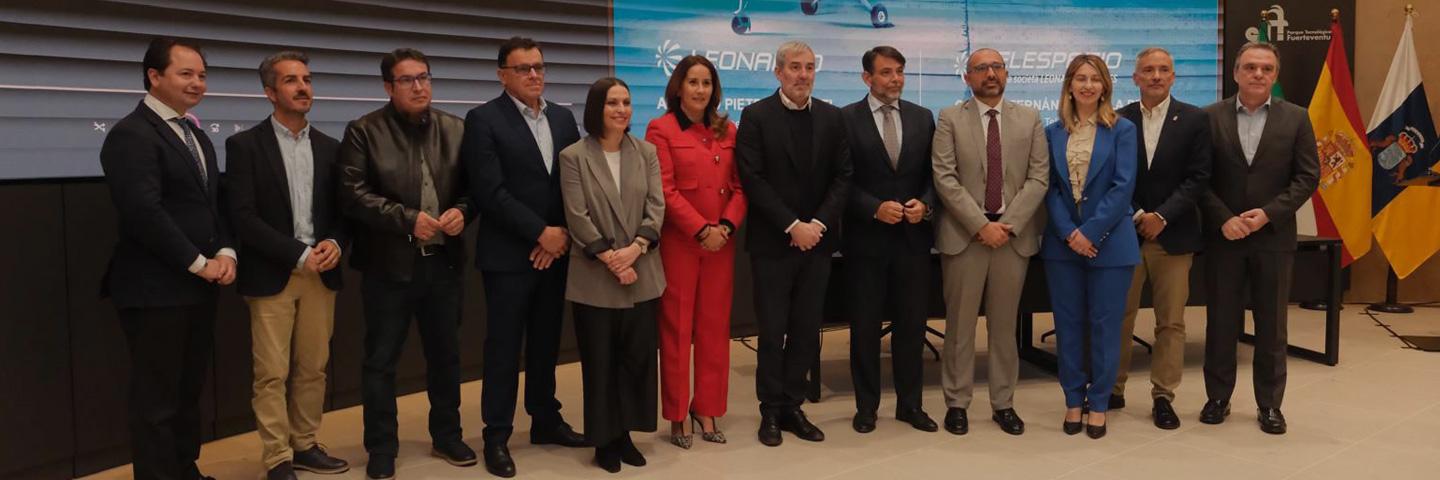
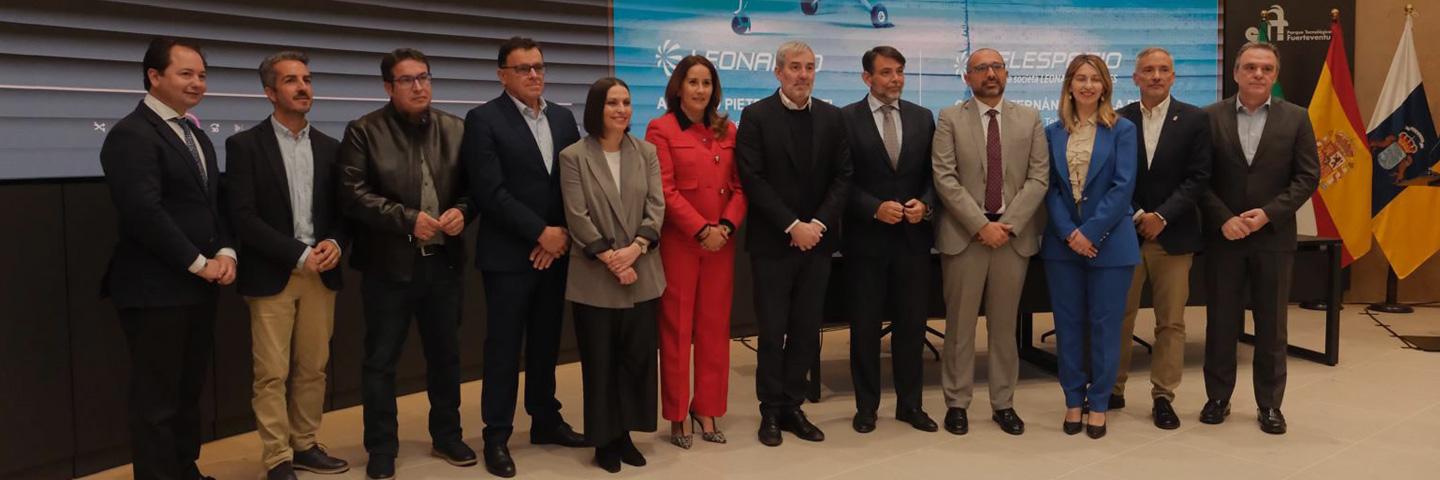
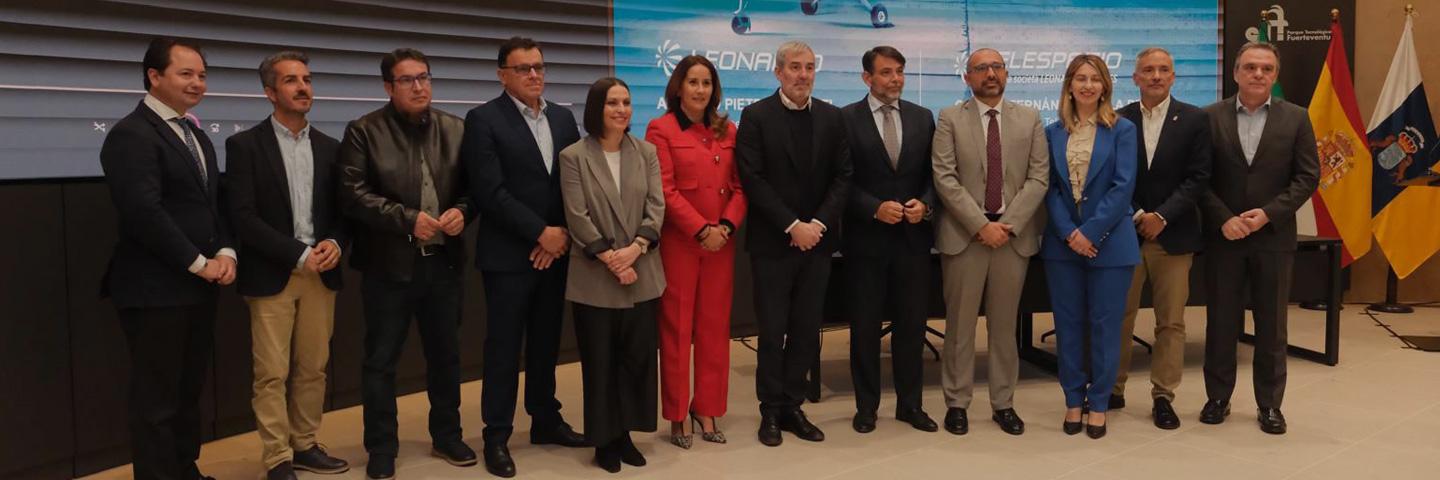
The agreement was signed during an event at the Fuerteventura Technological Park, with key institutional figures, including the President of the Government of the Canary Islands, Fernando Clavijo. Alberto Pietro Berruti, Senior Vice President Sales of Leonardo’s Aircraft Division, commented: “We are proud to contribute with our technologies to this environmental protection and wildfire prevention program. The Falco EVO is an example of our advanced capabilities, combining aerospace platforms, sensors, and interoperability. This collaboration aligns with Leonardo’s commitment to sustainability and the protection of natural resources.”
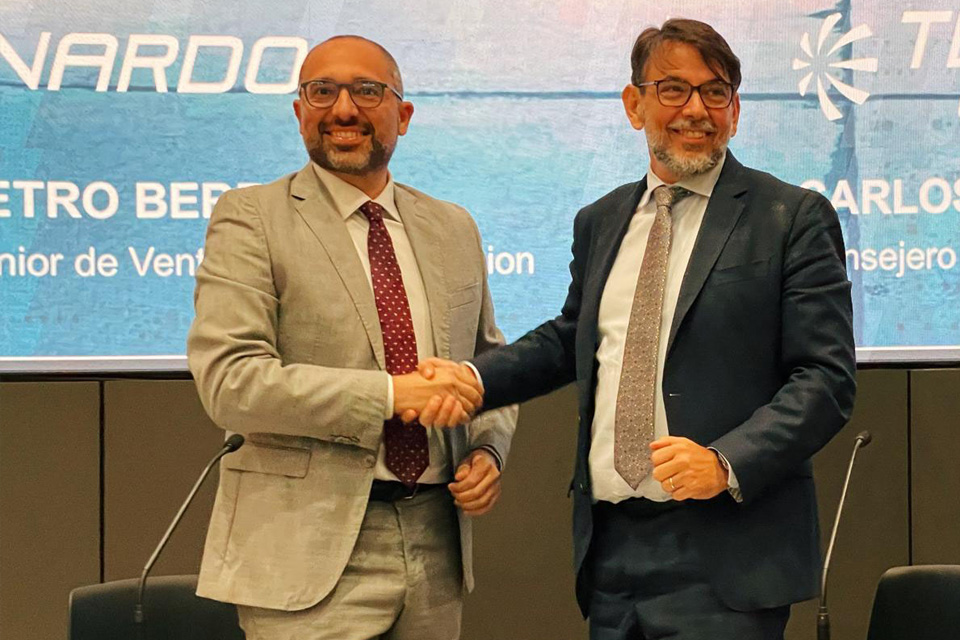
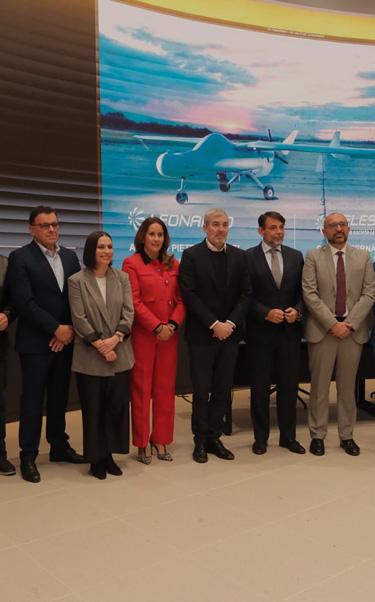
From left: Alberto Pietro Berruti, Vice President Sales of Leonardo's Aircraft Division and Carlos Fernández de la Peña, CEO of Telespazio Ibérica

In the image, the Falco EVO

This partnership is part of a broader initiative led by Telespazio Ibérica in collaboration with Pegasus Aero Group, which has already implemented a drone monitoring system in the Canary Islands. The deployment of the Falco EVO further strengthens this initiative, which aims to combat wildfires, increasingly frequent and intense due to climate change and complex biodiversity management. The Falco EVO’s ability to operate in extreme conditions (from -40ºC to 50ºC) and fly both day and night makes it an ideal tool for tackling complex wildfires, including sixth-generation fires that spread rapidly and are difficult to control.

The operations of the Falco EVO will also contribute to the management of natural disasters such as volcanic eruptions, flooding, and coastal and border surveillance, areas in which this UAV has already proven its effectiveness.

Other News & Stories

21.09.2026
Connectivity: results of the satellite trial in Lombardy presented in Milan

Connecting entire villages to the national network through an infrastructure that combines satellite, fiber and wireless connections, in order to bring quality digital services even to the hardest-to-reach areas. This is the goal of the trial carried out in Lombardy, whose preliminary results were presented at the Milan office of the Department for Digital Transformation. Telespazio took part in the initiative by developing a proprietary backhauling solution that aggregates multiple satellite links.

15.09.2026
FLEX and Sentinel-3C in Orbit: Leonardo and Telespazio's Contribution to ESA's Earth Observation Missions

On September 15th 2026, at 03:21 Italian time, the FLEX and Copernicus Sentinel-3C satellites of the European Space Agency (ESA) successfully launched from Europe's Spaceport in Kourou, French Guiana. Both travelled aboard the same launcher, Avio's Vega-C, and are now flying in tandem orbit, spaced roughly ten seconds apart, at an altitude of around 800 kilometres.

28.08.2026
MTG-I2 successfully launched: Telespazio acquired the first signal from the third Meteosat Third Generation satellite from the Fucino Space Centre

MTG-I2, the third Meteosat Third Generation satellite from ESA and EUMETSAT, lifted off yesterday, 27 August, at 20:11 UTC from the Kourou spaceport in French Guiana, aboard an Arianespace Ariane 6 launcher. About 25 minutes after launch, Telespazio's Fucino Space Centre — a Leonardo Group subsidiary — acquired the satellite's first signal, officially marking the start of the LEOP (Launch and Early Orbit Phase), which will last twelve days.

30.07.2026
Italy-France: the Fucino Space Centre welcomes the institutional visit of Ministers Urso and Baptiste

The Minister of Enterprises and Made in Italy and Delegated Authority for Space and Aerospace Policies, Sen. Adolfo Urso, and France's Minister for Higher Education, Research and Space, Philippe Baptiste, today visited Telespazio's Fucino Space Centre, in the presence of Marco Marsilio, President of the Abruzzo Region, as part of an initiative organized by Leonardo and Telespazio.

21.09.2026
Connectivity: results of the satellite trial in Lombardy presented in Milan

Connecting entire villages to the national network through an infrastructure that combines satellite, fiber and wireless connections, in order to bring quality digital services even to the hardest-to-reach areas. This is the goal of the trial carried out in Lombardy, whose preliminary results were presented at the Milan office of the Department for Digital Transformation. Telespazio took part in the initiative by developing a proprietary backhauling solution that aggregates multiple satellite links.

15.09.2026
FLEX and Sentinel-3C in Orbit: Leonardo and Telespazio's Contribution to ESA's Earth Observation Missions

On September 15th 2026, at 03:21 Italian time, the FLEX and Copernicus Sentinel-3C satellites of the European Space Agency (ESA) successfully launched from Europe's Spaceport in Kourou, French Guiana. Both travelled aboard the same launcher, Avio's Vega-C, and are now flying in tandem orbit, spaced roughly ten seconds apart, at an altitude of around 800 kilometres.

28.08.2026
MTG-I2 successfully launched: Telespazio acquired the first signal from the third Meteosat Third Generation satellite from the Fucino Space Centre

MTG-I2, the third Meteosat Third Generation satellite from ESA and EUMETSAT, lifted off yesterday, 27 August, at 20:11 UTC from the Kourou spaceport in French Guiana, aboard an Arianespace Ariane 6 launcher. About 25 minutes after launch, Telespazio's Fucino Space Centre — a Leonardo Group subsidiary — acquired the satellite's first signal, officially marking the start of the LEOP (Launch and Early Orbit Phase), which will last twelve days.

30.07.2026
Italy-France: the Fucino Space Centre welcomes the institutional visit of Ministers Urso and Baptiste

The Minister of Enterprises and Made in Italy and Delegated Authority for Space and Aerospace Policies, Sen. Adolfo Urso, and France's Minister for Higher Education, Research and Space, Philippe Baptiste, today visited Telespazio's Fucino Space Centre, in the presence of Marco Marsilio, President of the Abruzzo Region, as part of an initiative organized by Leonardo and Telespazio.