

First satellite of IRIDE constellation launched: Telespazio supports orbiting operations

21 January 2025

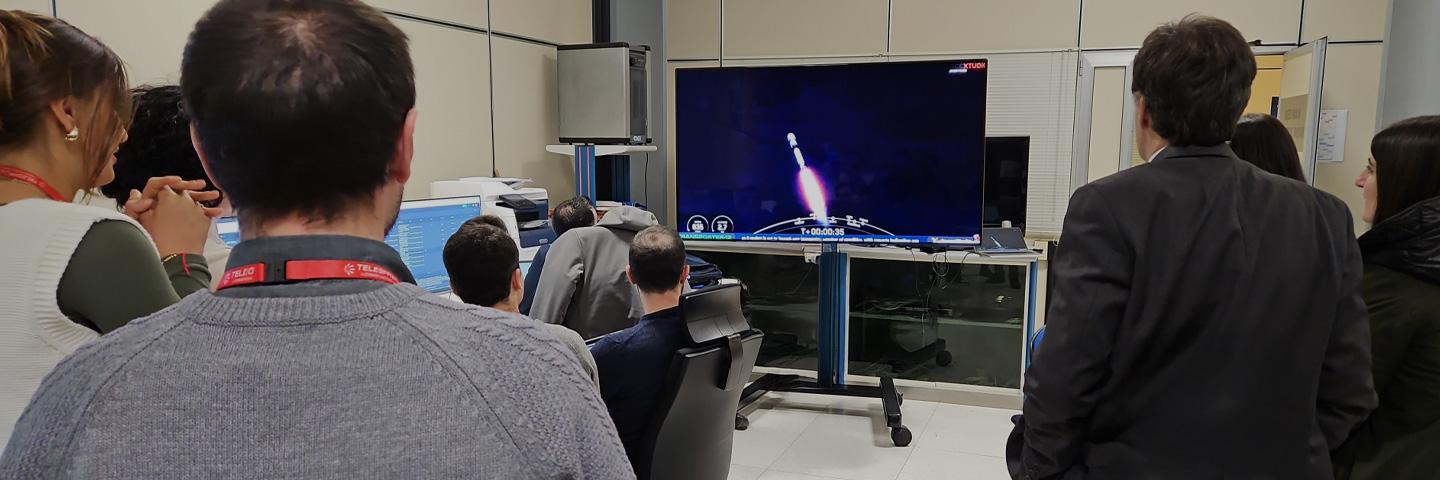
Pathfinder, the microsatellite precursor to HEO - one of the six constellations within the Italian IRIDE program - was successfully launched on January 14 from the Vandenberg base in California aboard a Falcon 9 rocket. The satellite, developed by ARGOTEC and coordinated by the European Space Agency (ESA) with the support of the Italian Space Agency (ASI), was released into orbit at approximately 590 km altitude and has since established regular contact with the Mission Control Center.

The Flight Control Team at ARGOTEC carried out the Pathfinder’s operations successfully. Telespazio, providing orbital determination services, played a crucial role during the critical Launch and Early Orbit Phase (LEOP), operating from its Fucino Space Center.

LEOP is a critical phase right after the satellite launch, where the satellite's systems are gradually activated and tested to ensure everything is working properly. During this phase, the satellite is also maneuvered from its initial orbit to its final one, setting it up for long-term operations.

Following the successful completion of the LEOP phase, the satellite has entered the Commissioning phase, which prepares it for nominal operations, with Telespazio providing support from the Fucino Space Center. This phase focuses on system optimization to ensure it is ready to deliver the data expected from the IRIDE program.

The IRIDE program envisions the creation of a “constellation of constellations”, an end-to-end Earth Observation’s system consisting of satellites in low orbit (Upstream Segment), the operational infrastructure on the ground (Downstream Segment) and services intended for the Public Administration (Service Segment).

The constellation will leverage various observation techniques and feature state-of-the-art satellites, serving both institutions and national startups and industrial entities. Upon completion, expected by mid-2026, IRIDE will enable frequent revisits of every Italian location, with a ground sampling distance of approximately two meters. Together with other national and European space systems, this new constellation will support Public Administrations, starting with Civil Protection, in combating hydrogeological instability and wildfires, safeguarding coastlines, and monitoring critical infrastructure, air quality, and weather conditions.

In this framework, Telespazio is responsible for developing the FOS (Flight Operations Segment) and managing flight operations up to the Commissioning phase for the Nimbus and Platino missions, as well as developing the MOC (Mission Operations Center) for the EAGLET mission.

Other News & Stories

17.12.2025
Two New Galileo Satellites Successfully Launched

Two new first-generation Galileo satellites, numbers 33 and 34, were successfully launched today aboard an Ariane 6 launcher at 06:01 (CET) Italian time from Europe’s Spaceport in Kourou, French Guiana. Galileo is Europe’s global satellite navigation system, developed by the European Union with the technical and industrial support of the European Space Agency (ESA).

16.12.2025
Love Planet Earth 2026: the Calendar by Leonardo, e-GEOS, Telespazio and Med-Or Italian Foundation on agriculture in the Mediterranean

On the occasion of 2025 Italian National Space Day, Leonardo, with e-GEOS (a joint venture 20% owned by the Italian Space Agency and 80% by Telespazio, Leonardo Group) and Telespazio (67% owned by Leonardo and 33% by Thales) present the eighteenth "Love Planet Earth" calendar, representing environmental sustainability through images taken by the COSMO-SkyMed satellites operated by the Italian Space Agency and the Italian Ministry of Defence.

11.12.2025
Leonardo, Telespazio and Intuitive Machines sign a strategic agreement for lunar communication and navigation

Leonardo, Telespazio and Intuitive Machines have signed a strategic cooperation agreement to develop interoperable infrastructures and provide communications and navigation services in support of lunar exploration.

13.11.2025
Agritech Living Lab: Telespazio at the forefront of agricultural innovation

Telespazio hosted the Agritech Living Lab at the Fucino Space Centre, an event organized within the framework of the Agritech Project, funded by the Italian Ministry of University and Research (MUR) under the National Recovery and Resilience Plan (NRRP), supported by the European Union’s NextGenerationEU initiative.

17.12.2025
Two New Galileo Satellites Successfully Launched

Two new first-generation Galileo satellites, numbers 33 and 34, were successfully launched today aboard an Ariane 6 launcher at 06:01 (CET) Italian time from Europe’s Spaceport in Kourou, French Guiana. Galileo is Europe’s global satellite navigation system, developed by the European Union with the technical and industrial support of the European Space Agency (ESA).

16.12.2025
Love Planet Earth 2026: the Calendar by Leonardo, e-GEOS, Telespazio and Med-Or Italian Foundation on agriculture in the Mediterranean

On the occasion of 2025 Italian National Space Day, Leonardo, with e-GEOS (a joint venture 20% owned by the Italian Space Agency and 80% by Telespazio, Leonardo Group) and Telespazio (67% owned by Leonardo and 33% by Thales) present the eighteenth "Love Planet Earth" calendar, representing environmental sustainability through images taken by the COSMO-SkyMed satellites operated by the Italian Space Agency and the Italian Ministry of Defence.

11.12.2025
Leonardo, Telespazio and Intuitive Machines sign a strategic agreement for lunar communication and navigation

Leonardo, Telespazio and Intuitive Machines have signed a strategic cooperation agreement to develop interoperable infrastructures and provide communications and navigation services in support of lunar exploration.

13.11.2025
Agritech Living Lab: Telespazio at the forefront of agricultural innovation

Telespazio hosted the Agritech Living Lab at the Fucino Space Centre, an event organized within the framework of the Agritech Project, funded by the Italian Ministry of University and Research (MUR) under the National Recovery and Resilience Plan (NRRP), supported by the European Union’s NextGenerationEU initiative.