

Italy on the internet: the way to the future passes through Fucino Space Centre

As the world held its breath over Chernobyl, Pisa connected to the American network for the first time. Using Telespazio antennas. The sixth episode in the “A Space Story” series. 

12 April 2021

Six p.m. on the 30th of April 1986, at the CNUCE offices in Via di Santa Maria, in Pisa. Information systems technician Antonio Blasco Bonito types in “Ping”, and in less than a second, a reply is received from the United States: “OK”. This apparently unexciting conversation between machines marks a true milestone, as Italy officially becomes the fourth country in Europe to connect to the American Arpanet network, soon to be known as the Internet.
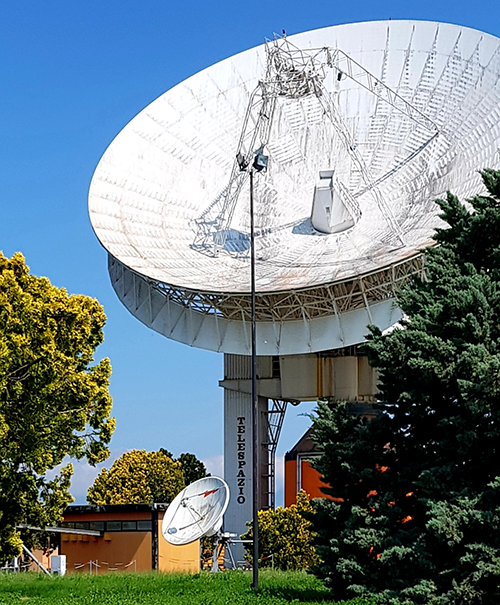
The satellite dish of the "Fucino Space Center" used to transmit the signal to the Intelsat V satellite and ensure the Arpanet connection between the United States and Italy.

On that Spring afternoon, the last piece of the puzzle that Bonito had been putting together with Luciano Lenzini and Stefano Trumpy over the course of six years was finally put in place. Connecting the computer in Pisa to the US network required preparation of a complex infrastructure capable of conveying a message to the other side of the world.

That Ping from the CNUCE travelled over a telephone cable belonging to SIP, which was Italy’s national telephone company at the time, to the Italcable station in Acilia. From there, it was redirected to the Fucino Space Centre, where a Telespazio antenna that is still in operation shot it off to the satellite Intelsat V and from there to its final destination, the Comsat station in Roaring Creek, Pennsylvania.
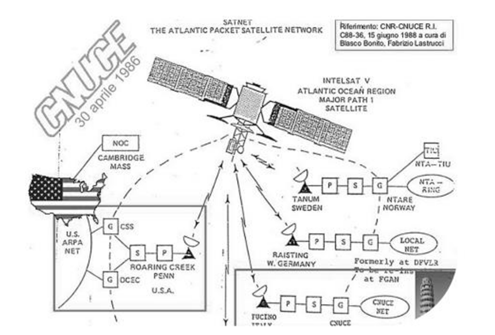
But this important milestone in history went entirely unnoticed at the time. The eyes of the world, and the media, were all on the nuclear power plant in Chernobyl, where one of the most serious accidents in history had taken place only four days earlier.

Unfortunate timing. And that’s not all. “Nobody understood what this really meant”, the three scientists commented several decades later. They themselves had no way of knowing “how much the Internet would change the world”. How do we know? It never even occurred to them to take a picture immortalising the moment.

Other News & Stories

17.12.2025
Two New Galileo Satellites Successfully Launched

Two new first-generation Galileo satellites, numbers 33 and 34, were successfully launched today aboard an Ariane 6 launcher at 06:01 (CET) Italian time from Europe’s Spaceport in Kourou, French Guiana. Galileo is Europe’s global satellite navigation system, developed by the European Union with the technical and industrial support of the European Space Agency (ESA).

16.12.2025
Love Planet Earth 2026: the Calendar by Leonardo, e-GEOS, Telespazio and Med-Or Italian Foundation on agriculture in the Mediterranean

On the occasion of 2025 Italian National Space Day, Leonardo, with e-GEOS (a joint venture 20% owned by the Italian Space Agency and 80% by Telespazio, Leonardo Group) and Telespazio (67% owned by Leonardo and 33% by Thales) present the eighteenth "Love Planet Earth" calendar, representing environmental sustainability through images taken by the COSMO-SkyMed satellites operated by the Italian Space Agency and the Italian Ministry of Defence.

11.12.2025
Leonardo, Telespazio and Intuitive Machines sign a strategic agreement for lunar communication and navigation

Leonardo, Telespazio and Intuitive Machines have signed a strategic cooperation agreement to develop interoperable infrastructures and provide communications and navigation services in support of lunar exploration.

13.11.2025
Agritech Living Lab: Telespazio at the forefront of agricultural innovation

Telespazio hosted the Agritech Living Lab at the Fucino Space Centre, an event organized within the framework of the Agritech Project, funded by the Italian Ministry of University and Research (MUR) under the National Recovery and Resilience Plan (NRRP), supported by the European Union’s NextGenerationEU initiative.

17.12.2025
Two New Galileo Satellites Successfully Launched

Two new first-generation Galileo satellites, numbers 33 and 34, were successfully launched today aboard an Ariane 6 launcher at 06:01 (CET) Italian time from Europe’s Spaceport in Kourou, French Guiana. Galileo is Europe’s global satellite navigation system, developed by the European Union with the technical and industrial support of the European Space Agency (ESA).

16.12.2025
Love Planet Earth 2026: the Calendar by Leonardo, e-GEOS, Telespazio and Med-Or Italian Foundation on agriculture in the Mediterranean

On the occasion of 2025 Italian National Space Day, Leonardo, with e-GEOS (a joint venture 20% owned by the Italian Space Agency and 80% by Telespazio, Leonardo Group) and Telespazio (67% owned by Leonardo and 33% by Thales) present the eighteenth "Love Planet Earth" calendar, representing environmental sustainability through images taken by the COSMO-SkyMed satellites operated by the Italian Space Agency and the Italian Ministry of Defence.

11.12.2025
Leonardo, Telespazio and Intuitive Machines sign a strategic agreement for lunar communication and navigation

Leonardo, Telespazio and Intuitive Machines have signed a strategic cooperation agreement to develop interoperable infrastructures and provide communications and navigation services in support of lunar exploration.

13.11.2025
Agritech Living Lab: Telespazio at the forefront of agricultural innovation

Telespazio hosted the Agritech Living Lab at the Fucino Space Centre, an event organized within the framework of the Agritech Project, funded by the Italian Ministry of University and Research (MUR) under the National Recovery and Resilience Plan (NRRP), supported by the European Union’s NextGenerationEU initiative.