

Galileo: four new satellites launched successfully

Kourou  17 November 2016

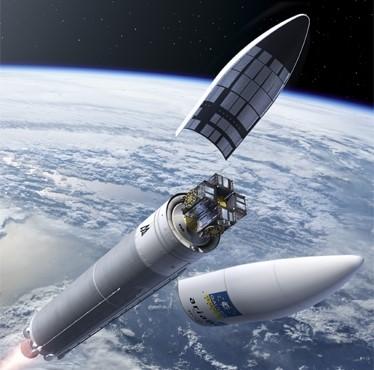
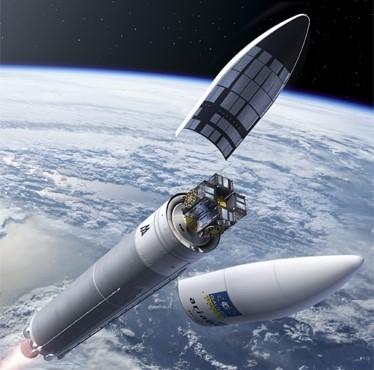
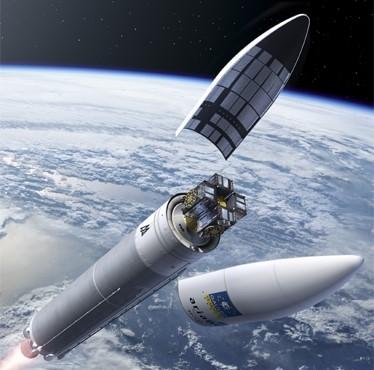
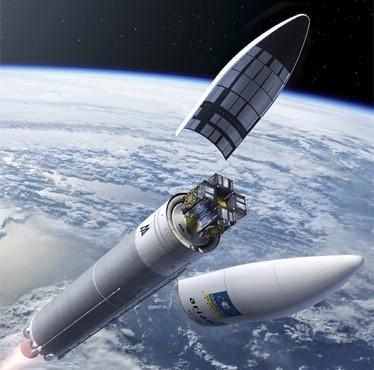
Four new satellites belonging to Galileo, the European satellite positioning and  navigation programme, were successfully launched today from the European spaceport in Kourou, French Guiana. The launch took place at 10:06 local time, 14:06 CET, with an Ariane 5 ES launcher.

Launch operations, from liftoff to satellite separation, lasted three hours and 55 minutes. In the next few days, the satellites will reach their final position in Medium Earth Orbit (MEO) at 22,900 km in altitude.

This launch brings to 18 the number of Galileo constellation satellites in orbit. Once completed, the Galileo constellation will consist of 30 satellites, although 24 will be enough to make the European satellite navigation network fully operational.

Italy has a key role in the development of the Galileo programme through the Italian Space Agency (ASI) and through the involvement of national industry, in particular of Leonardo-Finmeccanica, Telespazio and Thales Alenia Space.

In particular, Telespazio plays a leading role in Galileo, having created at the Fucino Space Centre one of the two Control Centres that manage the constellation and the programme mission.

In addition, through SpaceOpal - joint venture company formed with DLR/GfR - Telespazio is responsible for mission operations and the related security activities, providing the management and delivery of the navigation message.

After launch, the Galileo Control Centre in Fucino is involved in the IOT activities (In Orbit Test) of the programme, to verify the functionality and performance of the payload on board the satellites, and the subsequent addition of the new satellite to the mission operations.

During the launch operations, an important role is played by Telespazio France, which supports the CNES and Arianespace from Toulouse and Kourou in managing the Launch Centre in Guyana, in the launch and putting the satellites into orbit.

 Telespazio VEGA Deutschland is also heavily involved in many aspects of the Galileo programme, and operates mainly at the ESOC in Darmstadt.

Telespazio is involved in the validation phase of the programme's early services and in the implementation of applications based on Galileo, which will encourage the development and dissemination of innovative services in multiple sectors: transport, telecommunications, geodesy, oil exploration, and mining.

The Galileo programme is a collaboration of the European Union with the European Space Agency (ESA) to improve the technological independence of Europe and to define international standards for global satellite navigation systems. The purpose of the programme is the creation of a satellite navigation system capable of providing a reliable and high-precision global positioning service for all types of civilian applications, including aircraft systems, including remote piloted aircraft (drones).

Other News & Stories

02.04.2026
New Generation Builders: Space Division’s Development program

The final event of the “New Generation Builders – Where Ideas Meet Purpose” program took place on March 10 at the Acquario Romano. The initiative brought together 80 colleagues from across the Space Division: Leonardo, Telespazio, and e-GEOS.

30.03.2026
Telespazio selected to help support NASA’s Artemis II mission tracking

Telespazio, a Leonardo Group company, is among the participants selected by NASA under the NASA’s Artemis II Orion One-Way Doppler Measurements Tracking initiative, dedicated to radio-tracking activities for the Artemis II mission, the first crewed mission of the Artemis program, which will see the Orion spacecraft perform an approximately ten-day test flight around the Moon.

19.02.2026
Telespazio Ibérica awarded contract to build the Canary Islands satellite constellation

Telespazio Ibérica, the Spanish subsidiary of Telespazio (a Leonardo Group company), has been awarded the €20 million contract to develop the Canary Islands satellite constellation, the first Earth observation system created by a Spanish autonomous community. The company will lead the project, build the ground segment, and manage the constellation.

12.02.2026
Membership of the Abruzzo Aerospace District (DAAB) exceeds 60 after the first six months of activity

Strategic and Technological Plan approved at the Members’ Assembly

02.04.2026
New Generation Builders: Space Division’s Development program

The final event of the “New Generation Builders – Where Ideas Meet Purpose” program took place on March 10 at the Acquario Romano. The initiative brought together 80 colleagues from across the Space Division: Leonardo, Telespazio, and e-GEOS.

30.03.2026
Telespazio selected to help support NASA’s Artemis II mission tracking

Telespazio, a Leonardo Group company, is among the participants selected by NASA under the NASA’s Artemis II Orion One-Way Doppler Measurements Tracking initiative, dedicated to radio-tracking activities for the Artemis II mission, the first crewed mission of the Artemis program, which will see the Orion spacecraft perform an approximately ten-day test flight around the Moon.

19.02.2026
Telespazio Ibérica awarded contract to build the Canary Islands satellite constellation

Telespazio Ibérica, the Spanish subsidiary of Telespazio (a Leonardo Group company), has been awarded the €20 million contract to develop the Canary Islands satellite constellation, the first Earth observation system created by a Spanish autonomous community. The company will lead the project, build the ground segment, and manage the constellation.

12.02.2026
Membership of the Abruzzo Aerospace District (DAAB) exceeds 60 after the first six months of activity

Strategic and Technological Plan approved at the Members’ Assembly