

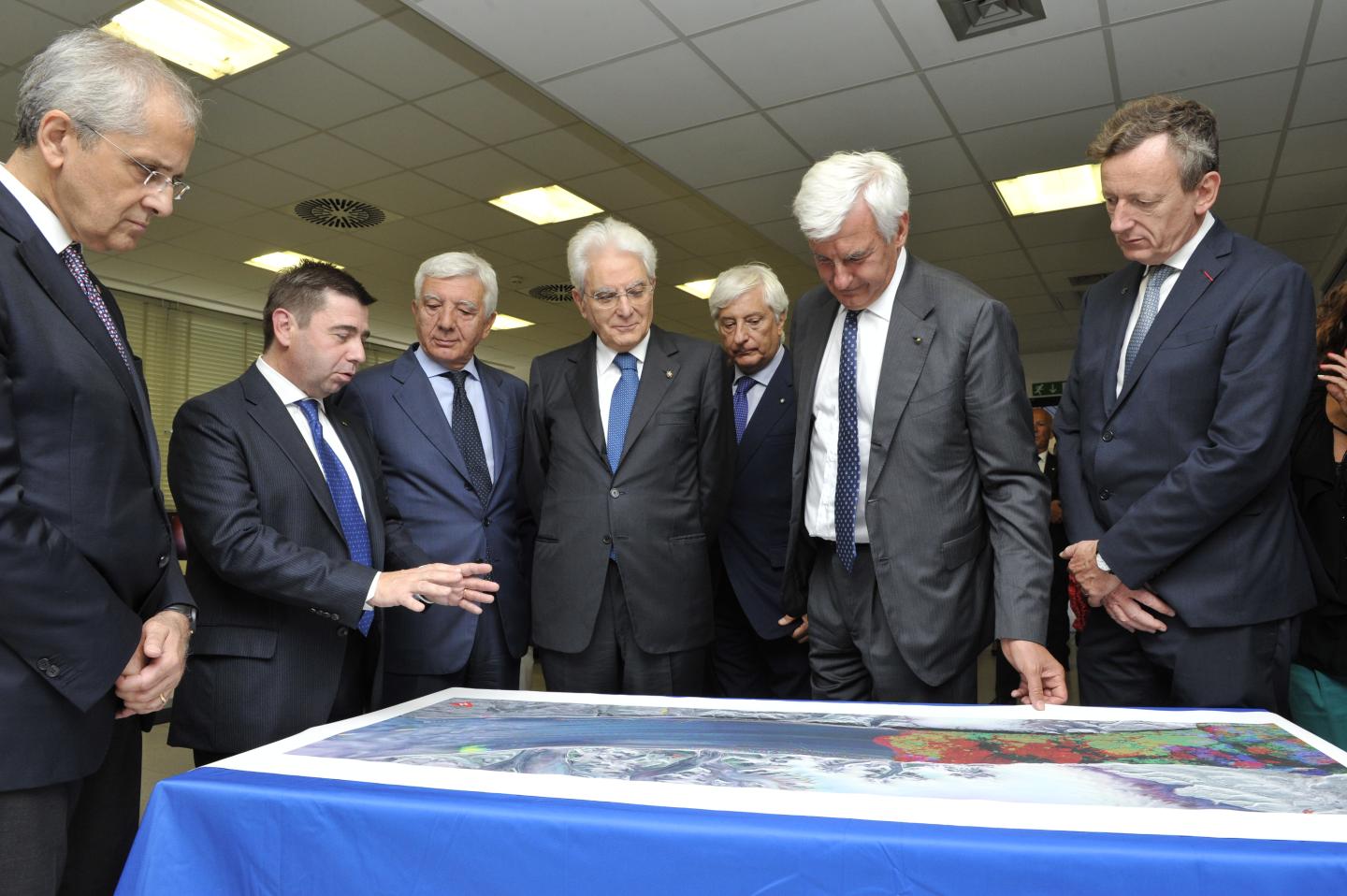
President of the Italian Republic Sergio Mattarella visited the Matera Space Hub

Matera Space Centre  17 July 2017

The President of the Italian Republic, Sergio Mattarella, today visited the Matera space hub, one of the most important centres in southern Italy for research, development and technology transfer, as well as one of the most advanced space facilities in Europe.

Welcoming the Head of State delegation were the President and General Director of the Italian Space Agency(ASI), Roberto Battiston and Anna Sirica, together with the Chairman and Chief Executive Officer of Leonardo, Giovanni De Gennaro and Alessandro Profumo.

With a surface area of around 100,000 m2, eight operating antennas and approximately 150 staff, the Matera space hub, comprising the  ASI Centre for Space Geodesy and the Matera Space Centre of e-GEOS (joint venture between Telespazio and ASI), is a leader in the supply of high-precision scientific data to users worldwide and geodesy, Earth observation and security accurate and timely services, which are taking on an increasingly important role for private and institutional clients on a global scale.

Matera is a centre of excellence for Earth observation on an international level, and a fundamental node in Leonardo's teleport network, comprising sites in Italy, Brazil, Argentina and Romania,” stated Alessandro Profumo, CEO of Leonardo. “Thanks to the state-of-the-art technologies used in our space centre and to the innovative contribution of the women and men that work here, we can receive and process data of crucial importance to the monitoring of our planet and of climate change, as well as to maritime security in the Mediterranean basin. Matera is also one of the key stations in the global geodetic network, a true show-piece for Italy in the world.”

The Centre for Space Geodesy is a fundamental node for the international scientific community, acting both as an observatory and a data analysis centre, with activities aimed at the precise determination of the basic geodetic parameters, like gravitational field, and geodynamic parameters of the Earth, like pole shift, earth tides and crustal displacement”, stated Roberto Battiston, President of ASI. “ASI has called for a strengthening of the Matera site both regarding the participation to the national Big Data infrastructure, and the involvement in Earth observation satellite systems such as the Italian COSMO-SkyMed and the European Copernicus programmes”.

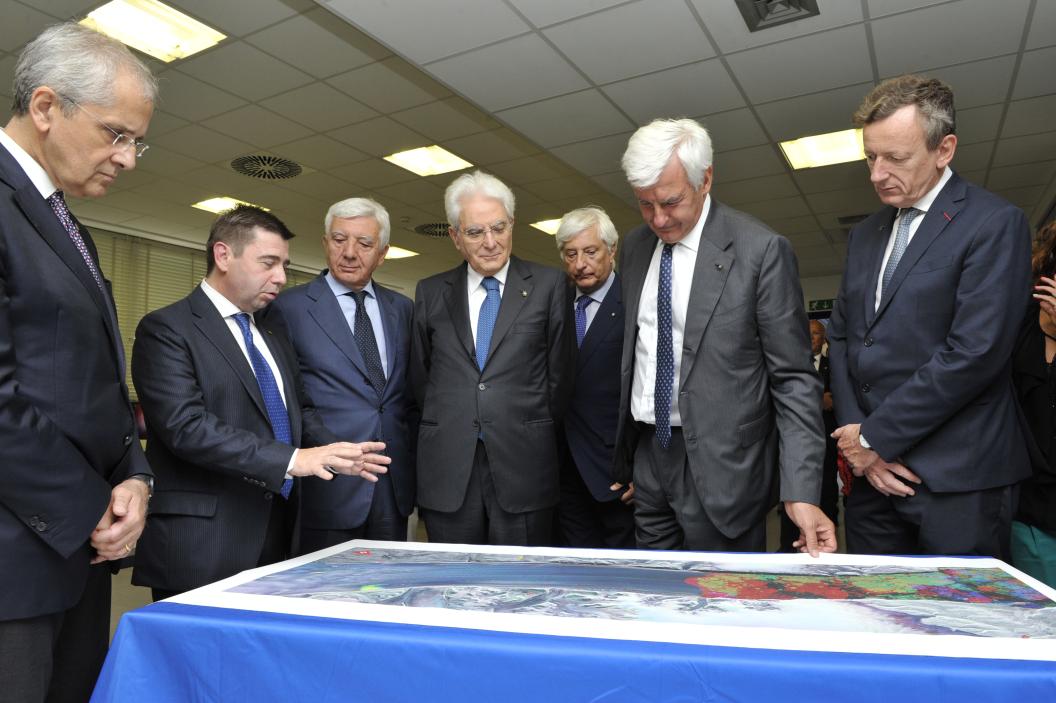
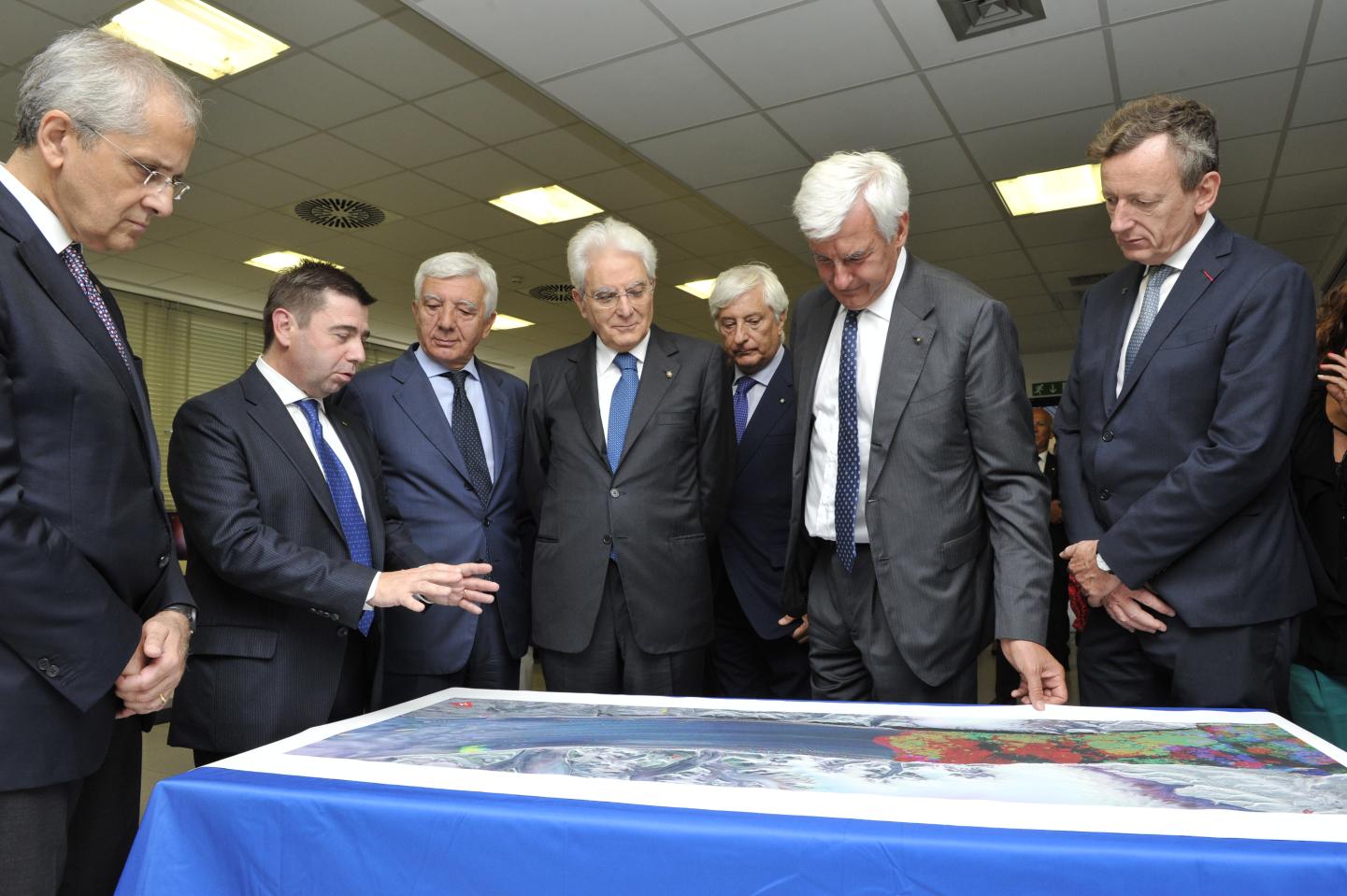
In the picture, from the left: Luigi Pasquali (Chief Executive Officer of Telespazio), Massimo Comparini (Chief Executive Officer of e-GEOS), Giovanni De Gennaro (Chairman of Leonardo), President Sergio Mattarella, Ugo Zampetti (Secretary General of the Presidency of the Republic) , Alessandro Profumo (Chief Executive Officer of Leonardo), Roberto Battiston (President of the Italian Space Agency).

Other News & Stories

06.05.2026
Greenerwave and Telespazio France sign strategic agreement to distribute multi-orbit, low-power and sovereign satcom terminals in europe

Telespazio France, a Leonardo group company, and Greenerwave, a French deeptech company, announce the signing of a strategic agreement aimed at deploying and distributing Greenerwave’s multi-orbit, energy-efficient and sovereign SATCOM terminals across the European defense and government markets.

05.05.2026
Open Innovation in the space sector: Leonardo and Telespazio honour the winners of the seven edition of #T-Tec

The award ceremony for the seventh edition of #T-TeC was held today in Rome, at the headquarters of the Italian Space Agency (ASI). The contest is an Open Innovation competition organised by Leonardo and Telespazio to foster technological innovation in the space sector among the younger generation of students and researchers from universities around the world.

30.04.2026
40 years ago, Italy’s first connection to the Internet thanks to the antennas of the Fucino space Centre

On April 30, 1986, Italy joined the global network that in the following years would become the Internet for the first time. The connection was made possible thanks to the key role of the Fucino space Centre, whose antennas carried the signal that connected the country with the United States.

02.04.2026
New Generation Builders: Space Division’s Development program

The final event of the “New Generation Builders – Where Ideas Meet Purpose” program took place on March 10 at the Acquario Romano. The initiative brought together 80 colleagues from across the Space Division: Leonardo, Telespazio, and e-GEOS.

06.05.2026
Greenerwave and Telespazio France sign strategic agreement to distribute multi-orbit, low-power and sovereign satcom terminals in europe

Telespazio France, a Leonardo group company, and Greenerwave, a French deeptech company, announce the signing of a strategic agreement aimed at deploying and distributing Greenerwave’s multi-orbit, energy-efficient and sovereign SATCOM terminals across the European defense and government markets.

05.05.2026
Open Innovation in the space sector: Leonardo and Telespazio honour the winners of the seven edition of #T-Tec

The award ceremony for the seventh edition of #T-TeC was held today in Rome, at the headquarters of the Italian Space Agency (ASI). The contest is an Open Innovation competition organised by Leonardo and Telespazio to foster technological innovation in the space sector among the younger generation of students and researchers from universities around the world.

30.04.2026
40 years ago, Italy’s first connection to the Internet thanks to the antennas of the Fucino space Centre

On April 30, 1986, Italy joined the global network that in the following years would become the Internet for the first time. The connection was made possible thanks to the key role of the Fucino space Centre, whose antennas carried the signal that connected the country with the United States.

02.04.2026
New Generation Builders: Space Division’s Development program

The final event of the “New Generation Builders – Where Ideas Meet Purpose” program took place on March 10 at the Acquario Romano. The initiative brought together 80 colleagues from across the Space Division: Leonardo, Telespazio, and e-GEOS.