

Fucino Space Centre: from the first "ping" to the future of the Internet

25 September 2026

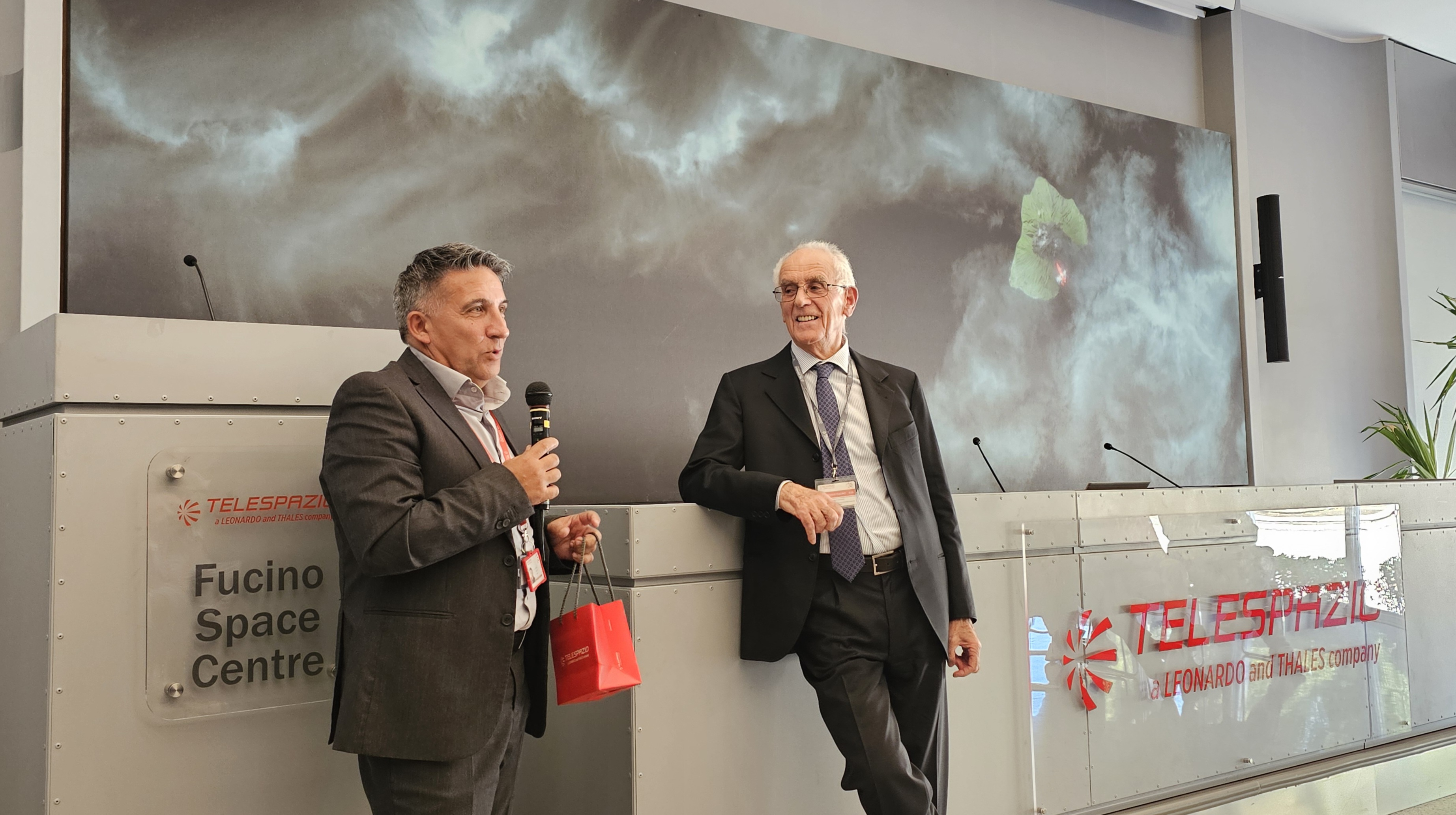
Prof. Luciano Lenzini, a pioneer in bringing the Internet to Italy, met with Telespazio engineers and technicians at the Fucino Space Centre, through which the first Internet link between Italy and the United States passed 40 years ago.

Forty years after the first "ping" that connected Italy to the Internet, Prof. Luciano Lenzini returned to the Fucino Space Centre to retrace the story of the birth and spread of the Net. On Friday, 25 September, speaking to Fucino employees, the University of Pisa professor looked back at the past, described the present and offered a glimpse of the Internet's future.

The story began on 30 April 1986, when a signal sent from CNUCE, the computing centre of the Italian National Research Council (CNR) in Pisa, reached the Roaring Creek station in Pennsylvania, connecting Italy for the first time to ARPANET, the US network that was the forerunner of the Internet. Lenzini conceived and designed the project together with Stefano Trumpy, then director of CNUCE, and Antonio Blasco Bonito, its technical lead. The satellite link ran over the SATNET network, made possible through the collaboration of CNR, Telespazio and Italcable, and used Telespazio's "historic" Fucino 1 antenna, which in 1969 had received the images of the first Moon landing. Italy thus became the fourth European country, after Norway, the United Kingdom and Germany, to be connected to the network created in the United States.

From these origins, the talk moved on to today's networks and to the frontier Lenzini is currently working on: the quantum Internet, which is set to profoundly transform communications over the next twenty years.

A native of Lucca, Lenzini was a researcher at CNUCE from 1970 to 1994 and then joined the Department of Information Engineering at the University of Pisa, where he still teaches. In 2016, he had already returned to Fucino for the filming of the RAI documentary "Login – Il giorno in cui l'Italia scoprì Internet" ("Login – The Day Italy Discovered the Internet"), marking 30 years since the Net arrived in Italy.

The event, promoted by Telespazio, was aimed in particular at newly hired colleagues. It gave them the chance to learn more about the origins of technologies and infrastructure that are now an integral part of their work, and to hear first-hand, from one of its protagonists, a story in which Telespazio played a decisive role.
Other News & Stories

25.09.2026
Fucino Space Centre: from the first "ping" to the future of the Internet

Prof. Luciano Lenzini, a pioneer in bringing the Internet to Italy, met with Telespazio engineers and technicians at the Fucino Space Centre, through which the first Internet link between Italy and the United States passed 40 years ago.

21.09.2026
Connectivity: results of the satellite trial in Lombardy presented in Milan

Connecting entire villages to the national network through an infrastructure that combines satellite, fiber and wireless connections, in order to bring quality digital services even to the hardest-to-reach areas. This is the goal of the trial carried out in Lombardy, whose preliminary results were presented at the Milan office of the Department for Digital Transformation. Telespazio took part in the initiative by developing a proprietary backhauling solution that aggregates multiple satellite links.

15.09.2026
FLEX and Sentinel-3C in Orbit: Leonardo and Telespazio's Contribution to ESA's Earth Observation Missions

On September 15th 2026, at 03:21 Italian time, the FLEX and Copernicus Sentinel-3C satellites of the European Space Agency (ESA) successfully launched from Europe's Spaceport in Kourou, French Guiana. Both travelled aboard the same launcher, Avio's Vega-C, and are now flying in tandem orbit, spaced roughly ten seconds apart, at an altitude of around 800 kilometres.

28.08.2026
MTG-I2 successfully launched: Telespazio acquired the first signal from the third Meteosat Third Generation satellite from the Fucino Space Centre

MTG-I2, the third Meteosat Third Generation satellite from ESA and EUMETSAT, lifted off yesterday, 27 August, at 20:11 UTC from the Kourou spaceport in French Guiana, aboard an Arianespace Ariane 6 launcher. About 25 minutes after launch, Telespazio's Fucino Space Centre — a Leonardo Group subsidiary — acquired the satellite's first signal, officially marking the start of the LEOP (Launch and Early Orbit Phase), which will last twelve days.

25.09.2026
Fucino Space Centre: from the first "ping" to the future of the Internet

Prof. Luciano Lenzini, a pioneer in bringing the Internet to Italy, met with Telespazio engineers and technicians at the Fucino Space Centre, through which the first Internet link between Italy and the United States passed 40 years ago.

21.09.2026
Connectivity: results of the satellite trial in Lombardy presented in Milan

Connecting entire villages to the national network through an infrastructure that combines satellite, fiber and wireless connections, in order to bring quality digital services even to the hardest-to-reach areas. This is the goal of the trial carried out in Lombardy, whose preliminary results were presented at the Milan office of the Department for Digital Transformation. Telespazio took part in the initiative by developing a proprietary backhauling solution that aggregates multiple satellite links.

15.09.2026
FLEX and Sentinel-3C in Orbit: Leonardo and Telespazio's Contribution to ESA's Earth Observation Missions

On September 15th 2026, at 03:21 Italian time, the FLEX and Copernicus Sentinel-3C satellites of the European Space Agency (ESA) successfully launched from Europe's Spaceport in Kourou, French Guiana. Both travelled aboard the same launcher, Avio's Vega-C, and are now flying in tandem orbit, spaced roughly ten seconds apart, at an altitude of around 800 kilometres.

28.08.2026
MTG-I2 successfully launched: Telespazio acquired the first signal from the third Meteosat Third Generation satellite from the Fucino Space Centre

MTG-I2, the third Meteosat Third Generation satellite from ESA and EUMETSAT, lifted off yesterday, 27 August, at 20:11 UTC from the Kourou spaceport in French Guiana, aboard an Arianespace Ariane 6 launcher. About 25 minutes after launch, Telespazio's Fucino Space Centre — a Leonardo Group subsidiary — acquired the satellite's first signal, officially marking the start of the LEOP (Launch and Early Orbit Phase), which will last twelve days.