

AWARE: A new milestone for Europe’s public warning system

06 November 2025

Telespazio France leads the second live demonstration of the AWARE project, using the Galileo constellation to deliver real-time emergency alerts in urban areas

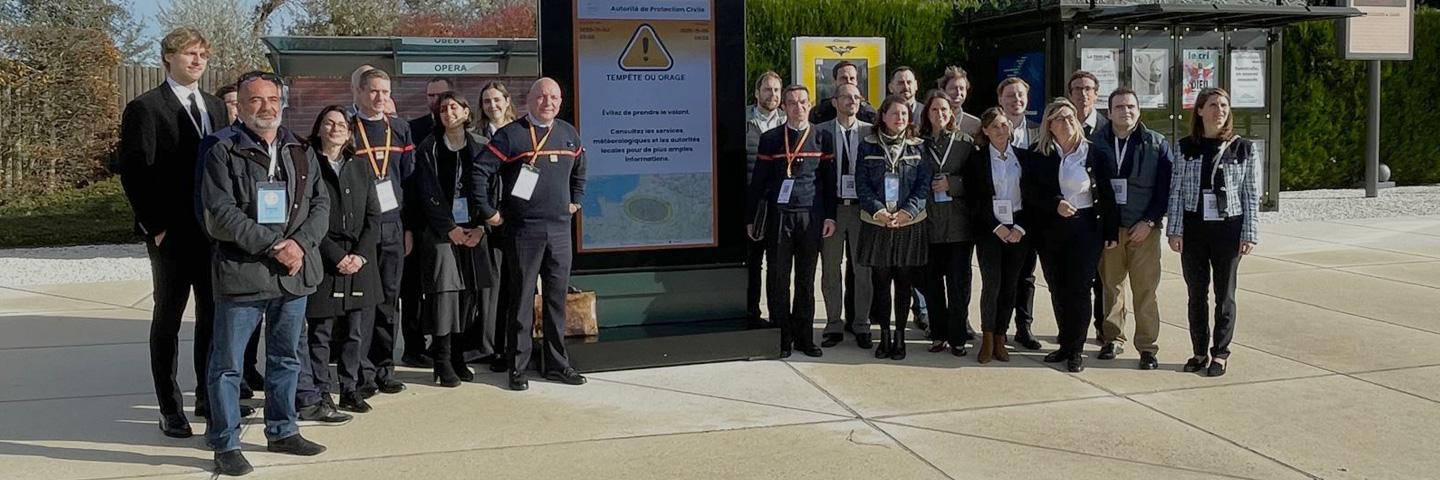
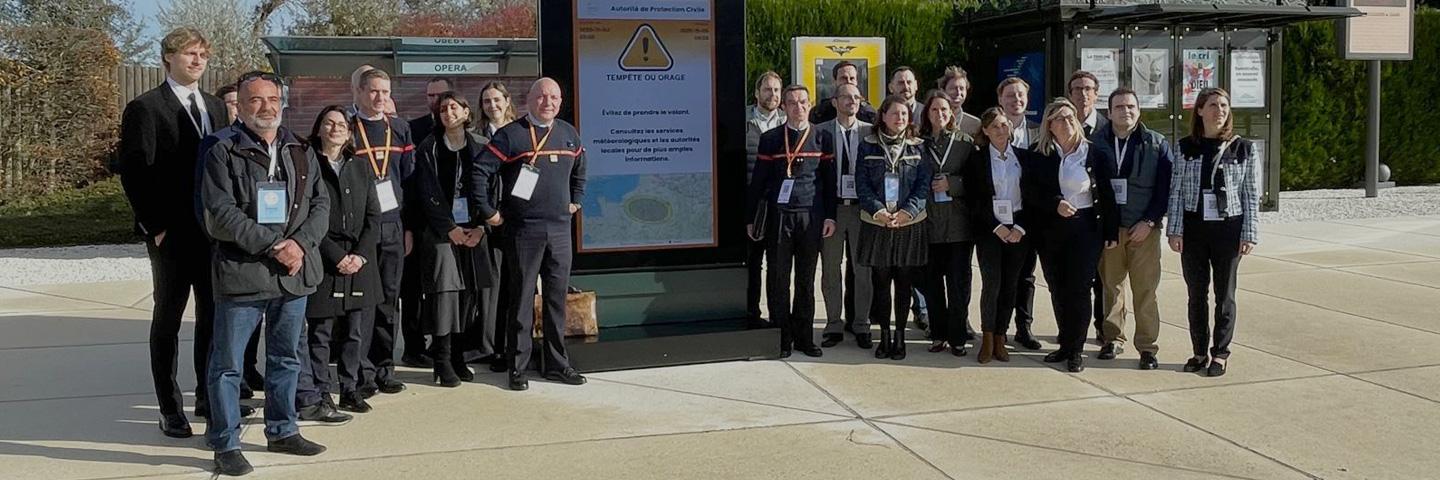
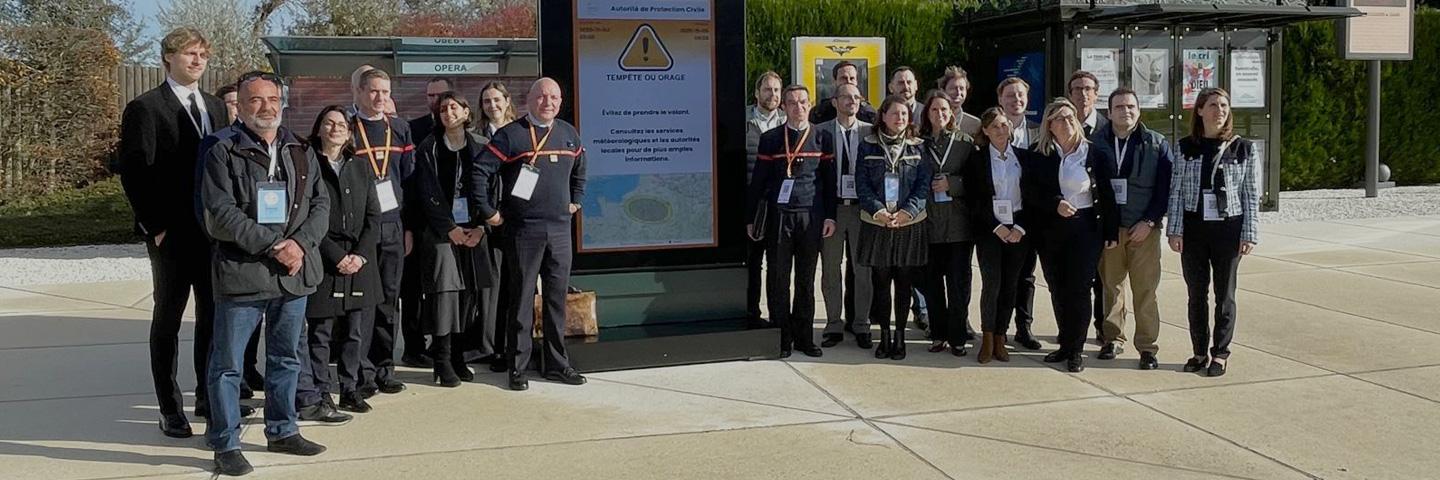
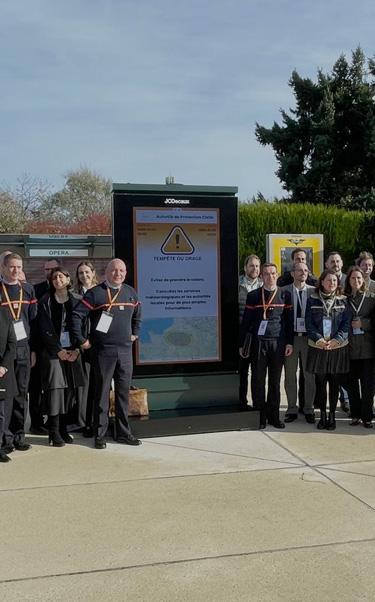
Ensuring the safety of citizens even when communication networks are down — this is the goal of the European project AWARE, coordinated by Telespazio France and funded by the European Union Agency for the Space Programme (EUSPA). The project has reached a new milestone with its second live demonstration of the public warning system, held at the JCDecaux headquarters in Plaisir, in the Île-de-France region.

The initiative showcased how the satellite signal from the Galileo Emergency Warning Satellite Service (EWSS) can be used to broadcast emergency messages directly in public spaces, through JCDecaux’s digital information displays. In the event of an alert — such as an extreme weather event, a fire, or an industrial accident — the AWARE module enables visual and audio warnings to be disseminated in real time, even without mobile network coverage or an internet connection.

During the simulation, which replicated a severe thunderstorm and a hazardous materials incident near the city center, the digital panels connected to the system received the satellite signal and broadcast an immediate alert message, demonstrating the effectiveness of the link with Galileo. The result confirms the potential of space innovation to enhance urban safety and resilience.

The event brought together representatives from the AWARE consortium, civil protection authorities, and public decision-makers, who were able to observe the system’s speed and precision in turning a satellite signal into a localized alert message. The demonstration confirmed the technological and operational maturity of the AWARE module, designed to complement existing warning systems and expand communication capacity in crisis situations.

Coordinated by Telespazio France, the AWARE project brings together eight partners from four countries: CNES, FDC, JCDecaux, and the University of Strasbourg (France); EENA (Belgium); Genasys (Spain); and the Civil Protection Authority of Slovenia.

Following the first demonstration in Slovenia, the 2025 French edition confirms the system’s robustness and adaptability even in complex urban environments, marking an important step toward a safer, more interconnected, and more resilient Europe ready to face the emergencies of the future.

Other News & Stories

25.09.2026
Fucino Space Centre: from the first "ping" to the future of the Internet

Prof. Luciano Lenzini, a pioneer in bringing the Internet to Italy, met with Telespazio engineers and technicians at the Fucino Space Centre, through which the first Internet link between Italy and the United States passed 40 years ago.

21.09.2026
Connectivity: results of the satellite trial in Lombardy presented in Milan

Connecting entire villages to the national network through an infrastructure that combines satellite, fiber and wireless connections, in order to bring quality digital services even to the hardest-to-reach areas. This is the goal of the trial carried out in Lombardy, whose preliminary results were presented at the Milan office of the Department for Digital Transformation. Telespazio took part in the initiative by developing a proprietary backhauling solution that aggregates multiple satellite links.

15.09.2026
FLEX and Sentinel-3C in Orbit: Leonardo and Telespazio's Contribution to ESA's Earth Observation Missions

On September 15th 2026, at 03:21 Italian time, the FLEX and Copernicus Sentinel-3C satellites of the European Space Agency (ESA) successfully launched from Europe's Spaceport in Kourou, French Guiana. Both travelled aboard the same launcher, Avio's Vega-C, and are now flying in tandem orbit, spaced roughly ten seconds apart, at an altitude of around 800 kilometres.

28.08.2026
MTG-I2 successfully launched: Telespazio acquired the first signal from the third Meteosat Third Generation satellite from the Fucino Space Centre

MTG-I2, the third Meteosat Third Generation satellite from ESA and EUMETSAT, lifted off yesterday, 27 August, at 20:11 UTC from the Kourou spaceport in French Guiana, aboard an Arianespace Ariane 6 launcher. About 25 minutes after launch, Telespazio's Fucino Space Centre — a Leonardo Group subsidiary — acquired the satellite's first signal, officially marking the start of the LEOP (Launch and Early Orbit Phase), which will last twelve days.

25.09.2026
Fucino Space Centre: from the first "ping" to the future of the Internet

Prof. Luciano Lenzini, a pioneer in bringing the Internet to Italy, met with Telespazio engineers and technicians at the Fucino Space Centre, through which the first Internet link between Italy and the United States passed 40 years ago.

21.09.2026
Connectivity: results of the satellite trial in Lombardy presented in Milan

Connecting entire villages to the national network through an infrastructure that combines satellite, fiber and wireless connections, in order to bring quality digital services even to the hardest-to-reach areas. This is the goal of the trial carried out in Lombardy, whose preliminary results were presented at the Milan office of the Department for Digital Transformation. Telespazio took part in the initiative by developing a proprietary backhauling solution that aggregates multiple satellite links.

15.09.2026
FLEX and Sentinel-3C in Orbit: Leonardo and Telespazio's Contribution to ESA's Earth Observation Missions

On September 15th 2026, at 03:21 Italian time, the FLEX and Copernicus Sentinel-3C satellites of the European Space Agency (ESA) successfully launched from Europe's Spaceport in Kourou, French Guiana. Both travelled aboard the same launcher, Avio's Vega-C, and are now flying in tandem orbit, spaced roughly ten seconds apart, at an altitude of around 800 kilometres.

28.08.2026
MTG-I2 successfully launched: Telespazio acquired the first signal from the third Meteosat Third Generation satellite from the Fucino Space Centre

MTG-I2, the third Meteosat Third Generation satellite from ESA and EUMETSAT, lifted off yesterday, 27 August, at 20:11 UTC from the Kourou spaceport in French Guiana, aboard an Arianespace Ariane 6 launcher. About 25 minutes after launch, Telespazio's Fucino Space Centre — a Leonardo Group subsidiary — acquired the satellite's first signal, officially marking the start of the LEOP (Launch and Early Orbit Phase), which will last twelve days.