

Telespazio at Farnborough Airshow

Farnborough  11 July 2016

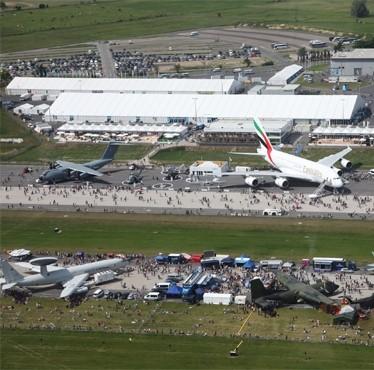
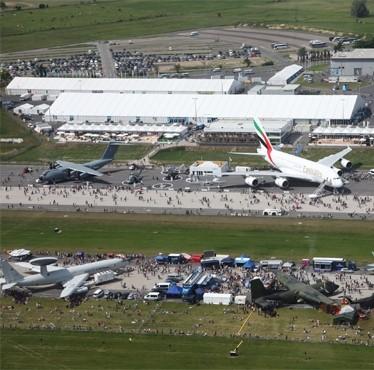
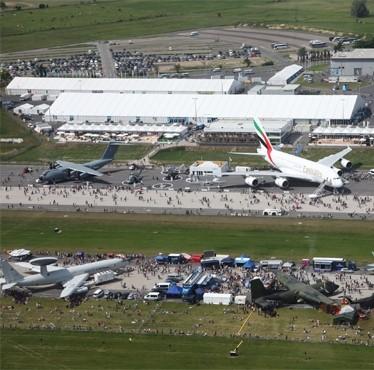
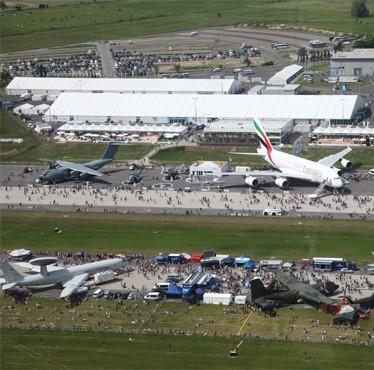
Telespazio takes part at the 2016 Farnborough Airshow (London), which will be held July 11 to 17. In Leonardo-Finmeccanica's exhibition area, the company will present the main activities in the field of space applications and systems, satellite operations and communications, and geo-information services.

In addition, the role of Telespazio in the major European space programmes will be outlined. These include satellite navigation and tracking (Egnos and Galileo), Earth observation (Copernicus and COSMO-SkyMed), and military satellite communications (SICRAL and ATHENA-FIDUS).

In the field of Geo-information, Telespazio will present in London the main application services, which are provided through its subsidiaries e-GEOS (ASI/Telespazio) and Telespazio VEGA UK. The advantages provided by the four satellites of the Italian COSMO-SkyMed constellation will be illustrated. This is the most advanced in the world in the fields of radar from space, defence, and security. The resulting data is marketed worldwide by e-GEOS.

e-GEOS will present new technological platforms related to the world of Image Intelligence and land protection based on geo-information.

SEnSE (the solution dedicated to monitoring the sea and its security) enables the identification of non-cooperating vessels, even in areas not covered by coastal radar, thanks to the integration with AIS data and the use of the COSMO-SkyMed, RadarSAT, and Sentinel radar images. Moreover, thanks to specific e-GEOS processors, it supports the observation of critical areas for environmental protection, detecting oil spills and abnormal behaviour by ships.

braINT (the Image Intelligence platform) supports the activities of analysis, extraction, integration, and sharing of intelligence reports, starting from the so-called GeoSpatial data, "enriching them" with OSINT data. The platform guides specialized operators in implementing activities such as damage assessment, remote area planning, and change detection.

Telespazio is also a leading industrial partner in Copernicus, the European Space Agency's environmental monitoring programme that to date has put four satellites in orbit. The e-GEOS Matera Space Centre is one of the three stations of the Copernicus Core Ground Segment, and it receives the radar and optical data acquired by the Sentinel-1 and Sentinel-2 missions, as well as data from COSMO-SkyMed, Landsat-8, and many more satellites. The Centre is now a truly global hub for geo-information services.

At Farnborough, Telespazio will also present its activities in the field of satellite navigation. The company plays a leading role in the development of the Galileo programme, having created at the Fucino Space Centre one of the Control Centres (GCC) that manage the constellation and the programme mission. A second GCC was created by DLR GfR, company of the DLR German space agency, in Oberpfaffenhofen (Monaco of Bavaria). Through Spaceopal (50% Telespazio, 50% DLR GfR), the company responsible for operations and integrated logistics of the entire system, Telespazio participates significantly during all phases of Galileo's operating life. With the twin launch in last May 24, there are 14 Galileo satellites in orbit, and by the end of 2016 there will be 18. VIDEO - Leonardo for Galileo

Galileo and EGNOS (European Geostationary Navigation Overlay Service), the infrastructure that guarantees the enhancement of satellite navigation in Europe, will promote the development and dissemination of innovative applications and services in various sectors: transport, telecommunications, geodesy.

At the exhibition, ample space will be devoted to the services for tactical military satellite communications (Milsatcom): from the Italian SICRAL constellation to the French-Italian ATHENA-FIDUS programme. Based on the experience gained over the past years in various military and civilian market segments, Telespazio has developed on its own and with the support of third-party companies some products specifically for these markets. In particular, for the military and tactical segment, it presents BackPack 960K, a trolley-type tri-band antenna for tactical use, reliable and easily transportable, able to operate on various commercial satellites and on different frequency bands. VIDEO - Telespazio for Military Satellite Communication

Other News & Stories

25.09.2026
Fucino Space Centre: from the first "ping" to the future of the Internet

Prof. Luciano Lenzini, a pioneer in bringing the Internet to Italy, met with Telespazio engineers and technicians at the Fucino Space Centre, through which the first Internet link between Italy and the United States passed 40 years ago.

21.09.2026
Connectivity: results of the satellite trial in Lombardy presented in Milan

Connecting entire villages to the national network through an infrastructure that combines satellite, fiber and wireless connections, in order to bring quality digital services even to the hardest-to-reach areas. This is the goal of the trial carried out in Lombardy, whose preliminary results were presented at the Milan office of the Department for Digital Transformation. Telespazio took part in the initiative by developing a proprietary backhauling solution that aggregates multiple satellite links.

15.09.2026
FLEX and Sentinel-3C in Orbit: Leonardo and Telespazio's Contribution to ESA's Earth Observation Missions

On September 15th 2026, at 03:21 Italian time, the FLEX and Copernicus Sentinel-3C satellites of the European Space Agency (ESA) successfully launched from Europe's Spaceport in Kourou, French Guiana. Both travelled aboard the same launcher, Avio's Vega-C, and are now flying in tandem orbit, spaced roughly ten seconds apart, at an altitude of around 800 kilometres.

28.08.2026
MTG-I2 successfully launched: Telespazio acquired the first signal from the third Meteosat Third Generation satellite from the Fucino Space Centre

MTG-I2, the third Meteosat Third Generation satellite from ESA and EUMETSAT, lifted off yesterday, 27 August, at 20:11 UTC from the Kourou spaceport in French Guiana, aboard an Arianespace Ariane 6 launcher. About 25 minutes after launch, Telespazio's Fucino Space Centre — a Leonardo Group subsidiary — acquired the satellite's first signal, officially marking the start of the LEOP (Launch and Early Orbit Phase), which will last twelve days.

25.09.2026
Fucino Space Centre: from the first "ping" to the future of the Internet

Prof. Luciano Lenzini, a pioneer in bringing the Internet to Italy, met with Telespazio engineers and technicians at the Fucino Space Centre, through which the first Internet link between Italy and the United States passed 40 years ago.

21.09.2026
Connectivity: results of the satellite trial in Lombardy presented in Milan

Connecting entire villages to the national network through an infrastructure that combines satellite, fiber and wireless connections, in order to bring quality digital services even to the hardest-to-reach areas. This is the goal of the trial carried out in Lombardy, whose preliminary results were presented at the Milan office of the Department for Digital Transformation. Telespazio took part in the initiative by developing a proprietary backhauling solution that aggregates multiple satellite links.

15.09.2026
FLEX and Sentinel-3C in Orbit: Leonardo and Telespazio's Contribution to ESA's Earth Observation Missions

On September 15th 2026, at 03:21 Italian time, the FLEX and Copernicus Sentinel-3C satellites of the European Space Agency (ESA) successfully launched from Europe's Spaceport in Kourou, French Guiana. Both travelled aboard the same launcher, Avio's Vega-C, and are now flying in tandem orbit, spaced roughly ten seconds apart, at an altitude of around 800 kilometres.

28.08.2026
MTG-I2 successfully launched: Telespazio acquired the first signal from the third Meteosat Third Generation satellite from the Fucino Space Centre

MTG-I2, the third Meteosat Third Generation satellite from ESA and EUMETSAT, lifted off yesterday, 27 August, at 20:11 UTC from the Kourou spaceport in French Guiana, aboard an Arianespace Ariane 6 launcher. About 25 minutes after launch, Telespazio's Fucino Space Centre — a Leonardo Group subsidiary — acquired the satellite's first signal, officially marking the start of the LEOP (Launch and Early Orbit Phase), which will last twelve days.