

#COSMOSMHACK: first hackathon dedicated to innovative apps on COSMO-SkyMed ended successfully

Rome  01 December 2015

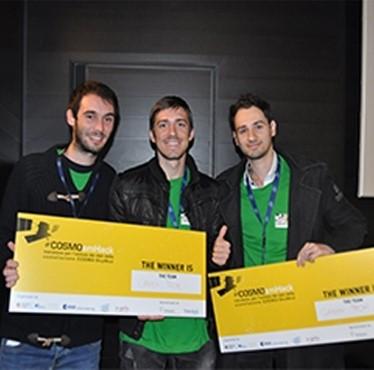
The "Aquaculture Project" for the study and monitoring of water quality through satellites and in-situ sensors, created by the GreenTech team, won on November 29 in Rome the "#COSMOsmHack", the first hackathon dedicated to the development of innovative applications based on data from the COSMO-SkyMed satellite constellation. 

Of the six teams competing, the winning team was the one composed of Daniele Trimarchi, Bogdan Surel, Alessio Zampatti, Paolo Roberto Di Gregorio and Domenico Cappello, all young students and researchers between 23 and 30 years old.

The team leader will have the opportunity to present the winning proposal at the 67th International Astronautical Congress (IAC), which will take place in Guadalajara (Mexico) in September 2016. The winning idea will benefit from up to three months of pre-incubation (analysis and feasibility study of the business model) and a subsequent six months of free incubation if the startup is launched. It will also benefit from the data necessary to build a prototype as part of the incubation, for a total of 5 thousand euros. Finally, after a positive evaluation of the startup, the team will be awarded 10 thousand euros for the costs of research and development during the first nine months of incubation.

The jury proposed a "special mention" for the EL-ISA team, which presented a project for the "mobile" and "social" management of natural disasters through the integration of data not only from satellite. This team consists of Davide Mancino, Vito Mezzapresa, Alessio Mitrotta and Justin Polidori, all 19 year-old students.

The initiative, a veritable "coding marathon" that lasted 24 hours, was promoted by ASI, e-GEOS is BIC Lazio - Companies of the Lazio Region, in collaboration with Telespazio and Thales Alenia Space Italy.

The competition was aimed at developing and promoting a "Proof of Concept" for innovative applications, to promote and encourage the development of new businesses in the field of research and innovation, supporting the creation of startups capable of building applications that can be used by institutions, businesses, and consumers.

Other News & Stories

25.09.2026
Fucino Space Centre: from the first "ping" to the future of the Internet

Prof. Luciano Lenzini, a pioneer in bringing the Internet to Italy, met with Telespazio engineers and technicians at the Fucino Space Centre, through which the first Internet link between Italy and the United States passed 40 years ago.

21.09.2026
Connectivity: results of the satellite trial in Lombardy presented in Milan

Connecting entire villages to the national network through an infrastructure that combines satellite, fiber and wireless connections, in order to bring quality digital services even to the hardest-to-reach areas. This is the goal of the trial carried out in Lombardy, whose preliminary results were presented at the Milan office of the Department for Digital Transformation. Telespazio took part in the initiative by developing a proprietary backhauling solution that aggregates multiple satellite links.

15.09.2026
FLEX and Sentinel-3C in Orbit: Leonardo and Telespazio's Contribution to ESA's Earth Observation Missions

On September 15th 2026, at 03:21 Italian time, the FLEX and Copernicus Sentinel-3C satellites of the European Space Agency (ESA) successfully launched from Europe's Spaceport in Kourou, French Guiana. Both travelled aboard the same launcher, Avio's Vega-C, and are now flying in tandem orbit, spaced roughly ten seconds apart, at an altitude of around 800 kilometres.

28.08.2026
MTG-I2 successfully launched: Telespazio acquired the first signal from the third Meteosat Third Generation satellite from the Fucino Space Centre

MTG-I2, the third Meteosat Third Generation satellite from ESA and EUMETSAT, lifted off yesterday, 27 August, at 20:11 UTC from the Kourou spaceport in French Guiana, aboard an Arianespace Ariane 6 launcher. About 25 minutes after launch, Telespazio's Fucino Space Centre — a Leonardo Group subsidiary — acquired the satellite's first signal, officially marking the start of the LEOP (Launch and Early Orbit Phase), which will last twelve days.

25.09.2026
Fucino Space Centre: from the first "ping" to the future of the Internet

Prof. Luciano Lenzini, a pioneer in bringing the Internet to Italy, met with Telespazio engineers and technicians at the Fucino Space Centre, through which the first Internet link between Italy and the United States passed 40 years ago.

21.09.2026
Connectivity: results of the satellite trial in Lombardy presented in Milan

Connecting entire villages to the national network through an infrastructure that combines satellite, fiber and wireless connections, in order to bring quality digital services even to the hardest-to-reach areas. This is the goal of the trial carried out in Lombardy, whose preliminary results were presented at the Milan office of the Department for Digital Transformation. Telespazio took part in the initiative by developing a proprietary backhauling solution that aggregates multiple satellite links.

15.09.2026
FLEX and Sentinel-3C in Orbit: Leonardo and Telespazio's Contribution to ESA's Earth Observation Missions

On September 15th 2026, at 03:21 Italian time, the FLEX and Copernicus Sentinel-3C satellites of the European Space Agency (ESA) successfully launched from Europe's Spaceport in Kourou, French Guiana. Both travelled aboard the same launcher, Avio's Vega-C, and are now flying in tandem orbit, spaced roughly ten seconds apart, at an altitude of around 800 kilometres.

28.08.2026
MTG-I2 successfully launched: Telespazio acquired the first signal from the third Meteosat Third Generation satellite from the Fucino Space Centre

MTG-I2, the third Meteosat Third Generation satellite from ESA and EUMETSAT, lifted off yesterday, 27 August, at 20:11 UTC from the Kourou spaceport in French Guiana, aboard an Arianespace Ariane 6 launcher. About 25 minutes after launch, Telespazio's Fucino Space Centre — a Leonardo Group subsidiary — acquired the satellite's first signal, officially marking the start of the LEOP (Launch and Early Orbit Phase), which will last twelve days.